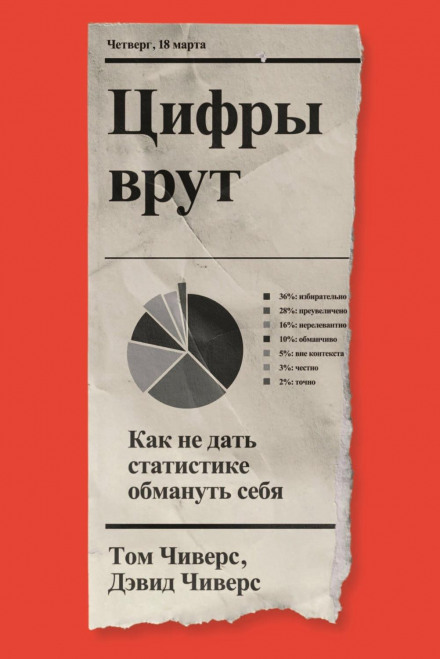
The Norm Chronicles: Stories and Numbers About Danger and Death
5 hrs. 29 min.
Language
Russian
Author
David Chivers
Author
Tom Chivers
Narrator
Tatyana Felgenhauer
Narrator
Tatyana Felgenhauer
Description
Reading before bed shortens your life. Video games provoke mass murders. Soda makes people aggressive. What?! No!
Every day the media writes about sensational discoveries and shocking results of research. But not all of it can be trusted: statistical errors, deliberate falsifications, and not-so-obvious flaws have not been canceled.
Because of the COVID-19 pandemic, humanity was forced to take an accelerated course in statistics: now we’re pretty good at reading graphs, we’ve heard something about the normal distribution, and we’re familiar with the survivor’s error. But there’s still so much to learn: how do mathematical models work? How do absolute and relative risks differ? What do rankings say? What is a Texas sharpshooter fallacy? Scientific journalist Tom Chivers and an economics professor at Durham University, David Chivers, use examples from headline-grabbing COVID-era stories to show how not to be fooled by numbers.
Every day the media writes about sensational discoveries and shocking results of research. But not all of it can be trusted: statistical errors, deliberate falsifications, and not-so-obvious flaws have not been canceled.
Because of the COVID-19 pandemic, humanity was forced to take an accelerated course in statistics: now we’re pretty good at reading graphs, we’ve heard something about the normal distribution, and we’re familiar with the survivor’s error. But there’s still so much to learn: how do mathematical models work? How do absolute and relative risks differ? What do rankings say? What is a Texas sharpshooter fallacy? Scientific journalist Tom Chivers and an economics professor at Durham University, David Chivers, use examples from headline-grabbing COVID-era stories to show how not to be fooled by numbers.
