Whole World Is a Single Flower
8 hrs. 51 min.
Description
One of the distinctive features of the collection “The Whole World Is One Flower” is its scope. Tae Son Sa Nim included not only koans of Chinese chan and Korean son, but also teachings of Laozi and the Christian tradition. Any religion is a language intended to express what lies beyond language. In the beginning there was the word, but before the beginning there wasn’t even a whisper. When Buddha lifted a flower, when Jesus took a child into his arms, they were saying the same thing. We can point to this by using the words of any religion. Thus, emptiness equals fullness, and the Kingdom of God equals the mind of the Bodhisattva. Koan practice teaches us to wait in the shadow of the cloud of not-knowing—looking where nothing can be seen, listening where nothing can be heard. Over time we understand that all solutions come to us on their own from the source of being, when we stop trying to control. The secret is trust. If we trust ourselves enough to not know, then we learn how to trust the shining ability to create the Tao—universal mind.
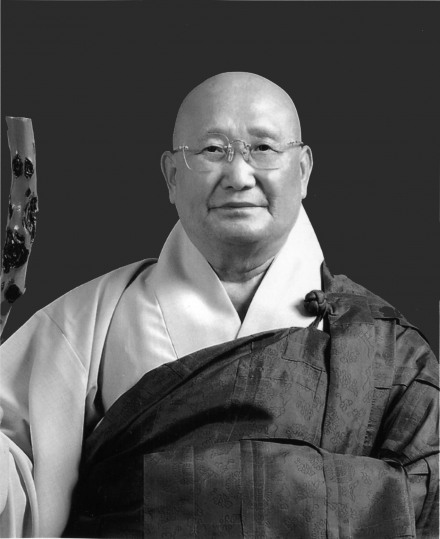
Sung San Tae Son Sa Nim (Korean: 숭산행원대선사) (1 August 1927 — 30 November 2004) — a Zen master of the Korean Buddhist order Jogye. Founder of the international Zen school Kwan Um. The seventy-eighth teacher in the lineage of the teaching from Shakyamuni Buddha. The first among Zen masters of Korean Buddhism to start teaching in the West. Taught intensively around the world starting in 1972 until his death. In recognition of his merits in spreading the teaching, the Jogye order granted him the title Tae Son Sa Nim (Great Honored Teacher).
Sung San Tae Son Sa Nim (Korean: 숭산행원대선사) (1 August 1927 — 30 November 2004) — a Zen master of the Korean Buddhist order Jogye. Founder of the international Zen school Kwan Um. The seventy-eighth teacher in the lineage of the teaching from Shakyamuni Buddha. The first among Zen masters of Korean Buddhism to start teaching in the West. Taught intensively around the world starting in 1972 until his death. In recognition of his merits in spreading the teaching, the Jogye order granted him the title Tae Son Sa Nim (Great Honored Teacher).
100%
44:05
01.Целый мир - один цветок
49:32
02.Целый мир - один цветок
51:03
03.Целый мир - один цветок
39:38
04.Целый мир - один цветок
44:15
05.Целый мир - один цветок
30:11
06.Целый мир - один цветок
36:49
07.Целый мир - один цветок
34:47
08.Целый мир - один цветок
30:40
09.1 Целый мир - один цветок
31:16
09.2 Целый мир - один цветок
33:22
10.1 Целый мир - один цветок
32:53
10.2 Целый мир - один цветок
36:12
11.1 Целый мир - один цветок
36:58
11.2 Целый мир - один цветок
