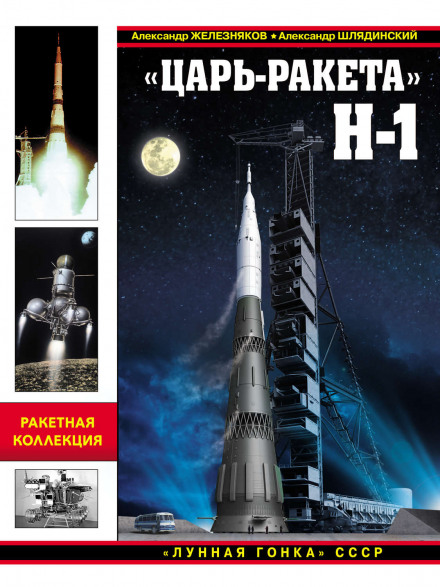
The 'Tsar Rocket' N-1: The USSR's Moon Race
4 hrs. 23 min.
Language
Russian
Author
Alexander Zheleznyakov
Author
Alexander Shlyadinsky
Narrator
Yuna Odirleya
Narrator
Yuna Odirleya
Description
“Tsar-Rocket” was the name given to the super-heavy N-1 launch vehicle for its colossal power and size (payload up to 100 tons, height over 100 meters—twice as much as the legendary R-7).
S. P. Korolev’s “Swan Song,” N-1 became the USSR’s main bet in the “lunar race,” and in the long run was supposed to ensure the assembly in orbit of the TMC (heavy interplanetary ship) for manned flights to Mars and Venus.
But just like the “Tsar Bell,” which was never rung, and the “Tsar Cannon,” which never took part in a battle, “Tsar-Rocket” never made it into space.
All four N-1 test launches failed, and after Korolev’s untimely death and the Americans’ landing on the Moon, the expensive program for creating a Soviet lunar base “Zvezda” was shut down.
Why did the USSR lose the “lunar race”?
Was it justified to stop work on the N-1 on the verge of a new breakthrough in Soviet space exploration?
Is it true that if Korolev had lived—driven by his titanium will and enormous authority—“Tsar-Rocket” would have been brought to perfection and the Soviet Union would have explored not only the Moon, but also Mars?
A new book by a leading historian of spaceflight answers all these questions. The collectors’ edition is illustrated with exclusive drawings and photographs.
S. P. Korolev’s “Swan Song,” N-1 became the USSR’s main bet in the “lunar race,” and in the long run was supposed to ensure the assembly in orbit of the TMC (heavy interplanetary ship) for manned flights to Mars and Venus.
But just like the “Tsar Bell,” which was never rung, and the “Tsar Cannon,” which never took part in a battle, “Tsar-Rocket” never made it into space.
All four N-1 test launches failed, and after Korolev’s untimely death and the Americans’ landing on the Moon, the expensive program for creating a Soviet lunar base “Zvezda” was shut down.
Why did the USSR lose the “lunar race”?
Was it justified to stop work on the N-1 on the verge of a new breakthrough in Soviet space exploration?
Is it true that if Korolev had lived—driven by his titanium will and enormous authority—“Tsar-Rocket” would have been brought to perfection and the Soviet Union would have explored not only the Moon, but also Mars?
A new book by a leading historian of spaceflight answers all these questions. The collectors’ edition is illustrated with exclusive drawings and photographs.
100%
27:26
00_Spisok sokrascheniy Predislovie
17:02
01_Avtomaty letyat k Lune
26:45
02_«My dolzhny pobyvat na Lune...»
38:31
03_Rozhdenie N-1
16:10
04_Raketa uchitsya letat
15:37
05_Drugie nositeli
19:53
06_Tyazhelyy mezhplanetnyy korabl
14:34
07_Korabl dlya obleta Luny
15:53
08_Kosmicheskiy kompleks N-1-L3
07:13
09_«Lunnye« kosmonavty
14:20
10_«Barmingrad«
30:09
11_«Lunnyy geolog« i lunohody
11:30
12_Zaklyuchenie
03:55
13_Spisok ispolzovannoy literatury
05:00
14_Chertezhi dlya modelistov
