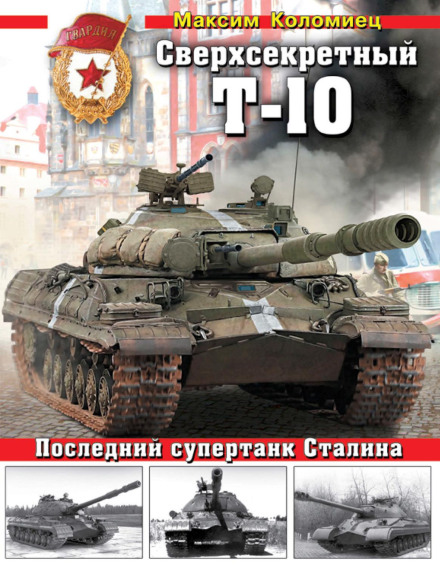
The Top-Secret T-10. Stalin's Last Super Tank
4 hrs. 14 min.
Language
Russian
Author
Maxim Kolomiyets
Author
Maxim Kolomiyets
Narrator
Bulat Davletov
Narrator
Bulat Davletov
Description
This heavy tank was accepted into service half a year after I.V. Stalin’s death, so the familiar abbreviation “IS” was replaced by T-10. Weighing 50 tons, this machine with a 120-mm “sickle-shaped” gun mantlet and an extremely powerful gun capable of penetrating more than 200 mm of armor surpassed all tanks of all likely opponents of the Soviet Army—and remained in service for 40 years (the last “tens” were removed from service only in 1993). Yet, perhaps, the T-10M is the least known of the domestic tanks because it wasn’t exported and was strictly classified in the USSR (even the operation manual had a security stamp). How did this tank perform during Operation “Dunay” in 1968, when our troops were introduced into Czechoslovakia? How many of these vehicles were actually produced (sources offered wildly different figures—from 1,400 to 8,000)? And why did the T-10 become the last heavy tank of the Soviet Union? Answering all these questions, a new book by a leading historian of armored vehicles restores, for the first time, the complete history of the creation, production, and 40-year service life of Stalin’s last “super tank.”
