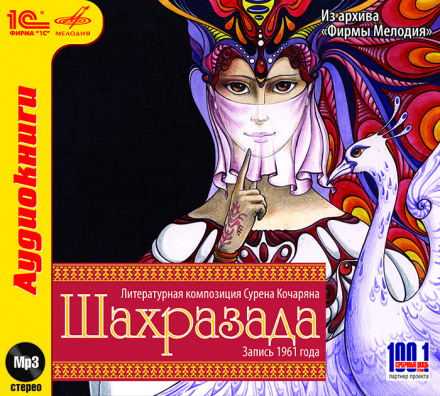
Scheherazade
1 hr. 32 min.
Description
There is no single “canonical” version of these fairy tales, and so far no manuscript—or any Arabic edition—has been found that matches the others in the main details. Probably the only part that remains the same in all versions of “One Thousand and One Nights,” and on which the entire plot is invariably built, is the story of King Shahryar and the wise daughter of his vizier, Shahrazada (Shaherazade). Enraged by his wife’s infidelity, Shahryar ordered that every night he be brought a new concubine, and in the morning he would execute her. One of these girls was Shahrazada, who devised a plan to put an end to the executions. She began telling the king a fairy tale and didn’t finish it before morning. Wanting to know what would happen next, the king postponed Shahrazada’s execution. This repeated for one thousand and one nights. Shahrazada was pardoned and became the king’s beloved wife.
100%
04:32
01 Шахразада. Часть 1
07:57
02 Шахразада. Часть 2
11:23
03 Шахразада. Часть 3
06:26
04 Шахразада. Часть 4
11:11
05 Шахразада. Часть 5
08:18
06 Шахразада. Часть 6
10:51
07 Шахразада. Часть 7
10:21
08 Шахразада. Часть 8
08:12
09 Шахразада. Часть 9
04:46
10 Шахразада. Часть 10
08:28
11 Шахразада. Часть 11
