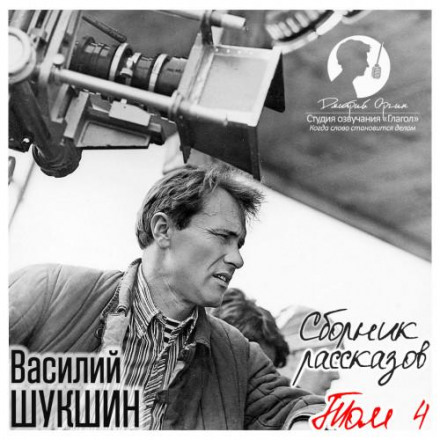
Short Story Collection. Volume 4
7 hrs. 55 min.
Language
Russian
Author
Vasily Shukshin
Author
Vasily Shukshin
Narrator
Dmitry Orgin
Narrator
Dmitry Orgin
Description
Blazing language, captivatingness, humor, vividness, the utmost authenticity of characters, simplicity and extraordinary depth of the stories—that’s the first thing that comes to mind when trying to describe Vasily Shukshin’s work “in general.”
Everyone knows that. But what about the not-obvious? Perhaps no one expressed the soul of the Russian “common man” as Shukshin did. And this isn’t just about the 1960s and 1970s; it’s about an inheritance that everyone can easily find in themselves. Want to understand the Russian man? Read Shukshin. Without a doubt! Because Shukshin’s stories are not only about the recent “past”—they’re also a mirror of the modern Russian soul.
In Russian literature there are three writers standing very close to each other… Gogol, Shukshin, and Chekhov. Or rather, Gogol, Chekhov, Shukshin, of course. Gogol lived 43 years, Chekhov 44, Shukshin 45. […]
All three wrote humorous stories. That’s why it’s easy to understand and love them. When a person laughs, he becomes better—because he stops “putting on airs,” stops trying to seem clever—or whatever it is he’s trying to be. His defenses weaken…
There was such a genre in our cinema—lyrical comedy. That’s when you sit down to laugh a bit—and then you cry. And you reflect on life. And you become so wise, so thoughtful—that’s just terrifying! As if each of them somehow understood something very important about life. And each of these three writers was, in that sense, a lyrical comedy. They didn’t burden you. They didn’t claim anything. They just… went out for a walk—light genre. And yet…
Shukshin-the-writer is “underrated” in our country, as funny as that sounds. […] When people say someone “underrated” something, it means that person underestimated the importance of the phenomenon for himself. And that means he “didn’t get enough,” didn’t take in enough of it. Didn’t fully perceive it. Took only the top layer.
© Lev Pirogov
Everyone knows that. But what about the not-obvious? Perhaps no one expressed the soul of the Russian “common man” as Shukshin did. And this isn’t just about the 1960s and 1970s; it’s about an inheritance that everyone can easily find in themselves. Want to understand the Russian man? Read Shukshin. Without a doubt! Because Shukshin’s stories are not only about the recent “past”—they’re also a mirror of the modern Russian soul.
In Russian literature there are three writers standing very close to each other… Gogol, Shukshin, and Chekhov. Or rather, Gogol, Chekhov, Shukshin, of course. Gogol lived 43 years, Chekhov 44, Shukshin 45. […]
All three wrote humorous stories. That’s why it’s easy to understand and love them. When a person laughs, he becomes better—because he stops “putting on airs,” stops trying to seem clever—or whatever it is he’s trying to be. His defenses weaken…
There was such a genre in our cinema—lyrical comedy. That’s when you sit down to laugh a bit—and then you cry. And you reflect on life. And you become so wise, so thoughtful—that’s just terrifying! As if each of them somehow understood something very important about life. And each of these three writers was, in that sense, a lyrical comedy. They didn’t burden you. They didn’t claim anything. They just… went out for a walk—light genre. And yet…
Shukshin-the-writer is “underrated” in our country, as funny as that sounds. […] When people say someone “underrated” something, it means that person underestimated the importance of the phenomenon for himself. And that means he “didn’t get enough,” didn’t take in enough of it. Didn’t fully perceive it. Took only the top layer.
© Lev Pirogov
100%
19:38
01. Сапожки
39:26
02. Как зайка летал на воздушных шариках
16:19
03. Ораторский приём
16:43
04. Ванька Тепляшин
23:05
05. Чудик
19:37
06. Выбираю деревню на жительство
19:46
07. Билетик на второй сеанс
30:52
08. Капроновая ёлочка
20:53
09. Генерал Малафейкин
14:05
10. Письмо
15:15
11. «Раскас»
13:42
12. В воскресенье мать-старушка…
1:14:03
13. Штрихи к портрету
20:01
14. Самые первые воспоминания
15:17
15. Заревой дождь
13:09
16. Забуксовал
29:24
17. Наказ
25:45
18. Лёля Селезнёва с факультета журналистики
23:51
19. Далёкие зимние вечер
24:27
20. Хахаль
