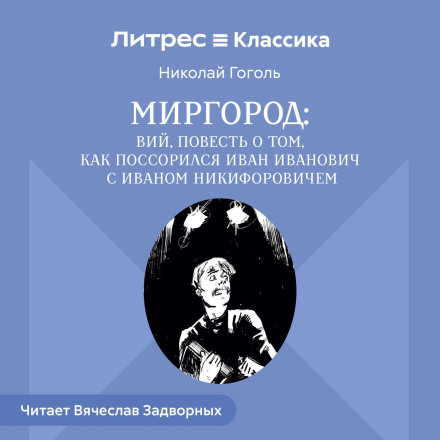
Mirgorod Collection. Viy. The Tale of How Ivan Ivanovich Quarreled with Ivan Nikiforovich
4 hrs. 12 min.
Language
Russian
Author
Nikolai Gogol
Author
Nikolai Gogol
Narrator
Vyacheslav Zadvornykh
Narrator
Vyacheslav Zadvornykh
Description
“Mirgorod” (February, 1835) — a collection of Nikolai Vasilyevich Gogol’s novellas, presented as a continuation of “Evenings on a Farm Near Dikanka.” The stories in this collection are based on Ukrainian folklore and have much in common. It is believed that some characters were modeled on Gogol’s relatives and on people he knew while living in Ukraine.
“Viy” is Gogol’s most fantastic work—a bountiful source for cinematic horror. Three burghers of sorts (seminary students) wander to visit a witch who has another form as well—a beautiful young lady; the main hero, Khoma Brut, finds himself drawn into a deadly adventure from which it is impossible to escape. Here, an erotic undertone is balanced by an exceptional naturalistic portrayal of the unclean, the horror of the otherworldly that seems to seep out of the text.
“The Tale of How Ivan Ivanovich Quarreled with Ivan Nikiforovich” features two small-town wealthy landowners, Ivan Ivanovich Pereredenko and Ivan Nikiforovich Dovhochkhun—best friends. People in Mirgorod say that “even the devil himself tied them up with a string.” One day a quarrel breaks out over a gun that Ivan Ivanovich wants to own; Ivan Nikiforovich calls his friend a goose, and that fateful word turns friendship into the bitterest feud involving lawsuits and the destruction of someone else’s property. In the magnificent four-part structure of “Mirgorod,” “Ivan Ivanovich with Ivan Nikiforovich” is the only novella responsible for pure comedy; however, even here, “through the laughter visible to the world,” Gogol’s despair shows through: a lawsuit between two former friends drags on for decades, consuming the remainder of their lives, and Gogol concludes the story with an exclamation: “Boring is life in this world, gentlemen!”
“Viy” is Gogol’s most fantastic work—a bountiful source for cinematic horror. Three burghers of sorts (seminary students) wander to visit a witch who has another form as well—a beautiful young lady; the main hero, Khoma Brut, finds himself drawn into a deadly adventure from which it is impossible to escape. Here, an erotic undertone is balanced by an exceptional naturalistic portrayal of the unclean, the horror of the otherworldly that seems to seep out of the text.
“The Tale of How Ivan Ivanovich Quarreled with Ivan Nikiforovich” features two small-town wealthy landowners, Ivan Ivanovich Pereredenko and Ivan Nikiforovich Dovhochkhun—best friends. People in Mirgorod say that “even the devil himself tied them up with a string.” One day a quarrel breaks out over a gun that Ivan Ivanovich wants to own; Ivan Nikiforovich calls his friend a goose, and that fateful word turns friendship into the bitterest feud involving lawsuits and the destruction of someone else’s property. In the magnificent four-part structure of “Mirgorod,” “Ivan Ivanovich with Ivan Nikiforovich” is the only novella responsible for pure comedy; however, even here, “through the laughter visible to the world,” Gogol’s despair shows through: a lawsuit between two former friends drags on for decades, consuming the remainder of their lives, and Gogol concludes the story with an exclamation: “Boring is life in this world, gentlemen!”
100%
30:17
01. Вий
20:04
02. Вий
20:29
03. Вий
14:53
04. Вий
14:42
05. Вий
16:11
06. Вий
13:39
07. Повесть о том, как поссорился Иван Иванович
24:56
08. Повесть о том, как поссорился Иван Иванович
13:38
09. Повесть о том, как поссорился Иван Иванович
29:23
10. Повесть о том, как поссорился Иван Иванович
13:42
11. Повесть о том, как поссорился Иван Иванович
17:59
12. Повесть о том, как поссорился Иван Иванович
22:39
13. Повесть о том, как поссорился Иван Иванович
