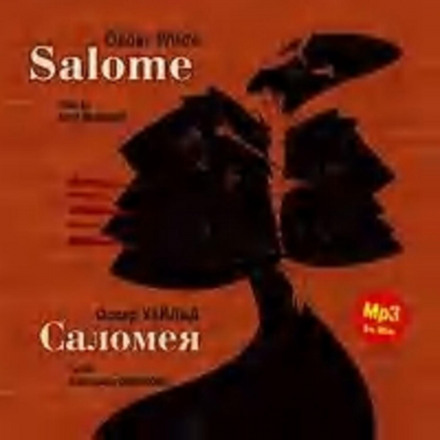
Salome
1 hr. 27 min.
Language
Russian
Author
Oscar Wilde
Author
Oscar Wilde
Narrator
Ekaterina Semenova
Narrator
Cora McDonald
Description
The drama “Salome” was written by the founder of Western European decadence, Wilde, in 1892 specifically for the great French actress Sarah Bernhardt. The premiere with her participation took place in Paris in 1896, but soon the production was banned by French censorship.
Wilde based the drama on the biblical myth of Salome— the stepdaughter of the Judean King Herod, an incredibly beautiful and seductive dancer. Herod himself was aflame with sinful passion for Salome, and when she performed the dance of the seven veils with special brilliance, he promised to grant her any desire. Meanwhile, the prophet John the Baptist was wandering through Judea, announcing the imminent coming of Jesus Christ. The Bible says that at the urging of her mother Herodias, whom John had branded as a seductress and a murderer, Salome demanded the king’s to deliver the prophet’s head. And she received it on a silver platter. Wilde added spice to the biblical tale: his Salome is far more corrupt. She skillfully uses her stepfather’s desire and other admirers’ attention, but she remains cold herself. “And this whole block of ice in the brilliance of cold and light lies at the feet of the rootless one.” Who is it? The very wandering prophet John. A holy man is foreign to carnal temptations, and he answers the passion of a whore with angry refusal. But Salome doesn’t give up: if he can’t be hers alive, she will acquire him dead…
It was Wilde’s Salome—not the biblical one—that inspired directors, composers, and artists for an entire century. In 1905, Richard Strauss wrote an opera with the same name. “Salome” is still not forgotten: in 1998, a performance based on Oscar Wilde’s play was staged by Roman Viktuk on the stage of the Russian Cultural Center, and to this day it has huge success.
Wilde based the drama on the biblical myth of Salome— the stepdaughter of the Judean King Herod, an incredibly beautiful and seductive dancer. Herod himself was aflame with sinful passion for Salome, and when she performed the dance of the seven veils with special brilliance, he promised to grant her any desire. Meanwhile, the prophet John the Baptist was wandering through Judea, announcing the imminent coming of Jesus Christ. The Bible says that at the urging of her mother Herodias, whom John had branded as a seductress and a murderer, Salome demanded the king’s to deliver the prophet’s head. And she received it on a silver platter. Wilde added spice to the biblical tale: his Salome is far more corrupt. She skillfully uses her stepfather’s desire and other admirers’ attention, but she remains cold herself. “And this whole block of ice in the brilliance of cold and light lies at the feet of the rootless one.” Who is it? The very wandering prophet John. A holy man is foreign to carnal temptations, and he answers the passion of a whore with angry refusal. But Salome doesn’t give up: if he can’t be hers alive, she will acquire him dead…
It was Wilde’s Salome—not the biblical one—that inspired directors, composers, and artists for an entire century. In 1905, Richard Strauss wrote an opera with the same name. “Salome” is still not forgotten: in 1998, a performance based on Oscar Wilde’s play was staged by Roman Viktuk on the stage of the Russian Cultural Center, and to this day it has huge success.
100%
00:52
rus_01
04:31
rus_02
03:55
rus_03
04:12
rus_04
04:10
rus_05
03:11
rus_06
04:12
rus_07
04:35
rus_08
03:37
rus_09
04:11
rus_10
03:30
rus_11
03:53
rus_12
04:34
rus_13
04:01
rus_14
02:35
rus_15
04:12
rus_16
04:22
rus_17
04:40
rus_18
04:07
rus_19
03:46
rus_20
03:01
rus_21
04:49
rus_22
02:09
rus_23
