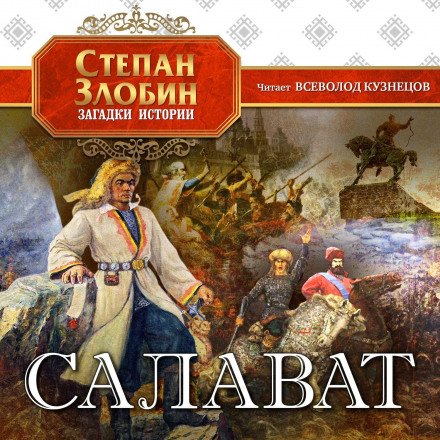
Salavat
58 min.
Language
Russian
Author
Stepan Zlobin
Author
Stepan Zlobin
Narrator
Vsevolod Kuznetsov
Narrator
Vsevolod Kuznetsov
Description
Salavat Yulaev is a national hero of Bashkiria, a fighter for the indigenous rights of the people of the land. One of the closest and most active associates of Yemelyan Pugachev during the Peasant War of 1773–1775. Despite his young age, he led the troops and took them to fight for a righteous cause. But his fame came not only from military feats. He wrote poems in his native language, praised his homeland, and without his creative work, the culture of Bashkiria would have lost its distinctive character. In this audiobook, you’ll hear about the exploits of this brave warrior and true patriot of his homeland.
“Salavat Yulaev” is a black-and-white 1940 film directed by Yakov Protazanov about Salavat Yulaev, the national hero of the Bashkir people, the leader of the Bashkirs in the peasant uprising under the command of Yemelyan Pugachev. It was released on screens on February 21, 1941.
In 1986, the film was restored at the M. Gorky Film Studio.
A story about the creation of the script
Screenwriter Stepan Zlobin recalled his work on the novel “Salavat Yulaev,” whose first version was published in 1929: “In the summer of 1924, I found myself in Ufa, where I was teaching literature and Russian. […] I took part in an expedition to the mountainous-steppe and mountainous-forest regions of Bashkiria; I rode a lot, stayed overnight in Bashkir nomad camps, hunted, studied the Bashkir language, and recorded songs, local legends, sayings, and proverbs. All of this, in the future, when I wrote ‘Salavat Yulaev,’ proved very useful. […] I set aside time to work in the historical archives of Ufa. I found interesting materials about Bashkir uprisings and decided to write ‘Salavat’…
I visited the village where Salavat was born and grew up—the village from which his wife came, the villages and hamlets where he recruited people into his detachment—into Pugachev’s troops, in places where he fought Catherine’s forces. There I learned about the nature surrounding Salavat’s childhood and was able to better imagine his life. Besides that, in those same places, people told me legends and tales about the national hero that had never been recorded anywhere before; they sang songs that traditions attribute to Salavat Yulaev.”
In 1939, it was decided to film S. Zlobin’s novel. In his autobiography, he wrote: “I went to Bashkiria again to stir up the old wine and make it ferment. And the theme of ‘Salavat’ suddenly ‘began to ferment.’ I understood how naive that twenty-five-year-old author of a children’s story about Salavat had been—how he couldn’t handle the portrayal of the historical process, and how necessary it was to do all of that again, completely differently, by rethinking the events of the 18th-century peasant war. I did this work in parallel with the work on the screenplay. In fact, a completely new novel ‘Salavat Yulaev’ saw the light only in 1941, when I was already at the front. And in spring of 1941, the film ‘Salavat Yulaev’ also appeared on screen, for which I worked on the script together with my wife.”
“Salavat Yulaev” is a black-and-white 1940 film directed by Yakov Protazanov about Salavat Yulaev, the national hero of the Bashkir people, the leader of the Bashkirs in the peasant uprising under the command of Yemelyan Pugachev. It was released on screens on February 21, 1941.
In 1986, the film was restored at the M. Gorky Film Studio.
A story about the creation of the script
Screenwriter Stepan Zlobin recalled his work on the novel “Salavat Yulaev,” whose first version was published in 1929: “In the summer of 1924, I found myself in Ufa, where I was teaching literature and Russian. […] I took part in an expedition to the mountainous-steppe and mountainous-forest regions of Bashkiria; I rode a lot, stayed overnight in Bashkir nomad camps, hunted, studied the Bashkir language, and recorded songs, local legends, sayings, and proverbs. All of this, in the future, when I wrote ‘Salavat Yulaev,’ proved very useful. […] I set aside time to work in the historical archives of Ufa. I found interesting materials about Bashkir uprisings and decided to write ‘Salavat’…
I visited the village where Salavat was born and grew up—the village from which his wife came, the villages and hamlets where he recruited people into his detachment—into Pugachev’s troops, in places where he fought Catherine’s forces. There I learned about the nature surrounding Salavat’s childhood and was able to better imagine his life. Besides that, in those same places, people told me legends and tales about the national hero that had never been recorded anywhere before; they sang songs that traditions attribute to Salavat Yulaev.”
In 1939, it was decided to film S. Zlobin’s novel. In his autobiography, he wrote: “I went to Bashkiria again to stir up the old wine and make it ferment. And the theme of ‘Salavat’ suddenly ‘began to ferment.’ I understood how naive that twenty-five-year-old author of a children’s story about Salavat had been—how he couldn’t handle the portrayal of the historical process, and how necessary it was to do all of that again, completely differently, by rethinking the events of the 18th-century peasant war. I did this work in parallel with the work on the screenplay. In fact, a completely new novel ‘Salavat Yulaev’ saw the light only in 1941, when I was already at the front. And in spring of 1941, the film ‘Salavat Yulaev’ also appeared on screen, for which I worked on the script together with my wife.”
