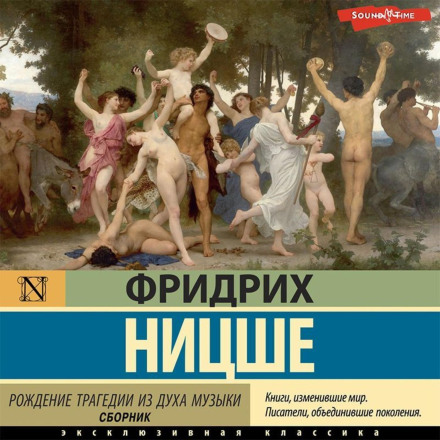
The Birth of Tragedy from the Spirit of Music (collection)
10 hrs. 48 min.
Language
Russian
Author
Friedrich Nietzsche
Author
Friedrich Nietzsche
Narrator
Igor Gmyza
Narrator
Evgeniy Shokin
Description
“The Birth of Tragedy Out of the Spirit of Music” is one of the most important treatises dealing with how tragedy is understood as a form of art.
It is in tragedy that the great philosopher saw an effective overcoming of nihilism and a way to justify life in all its troubles!
Friedrich Nietzsche (1844–1900) was a German philosopher, classical philologist, and poet—author of such well-known works as “Beyond Good and Evil,” “The Antichrist,” “Thus Spoke Zarathustra,” and others.
“The Birth of Tragedy Out of the Spirit of Music” is an aesthetic treatise in which Nietzsche set out his view of the origins of art that arose in Ancient Greece. In art, according to the philosopher, the ancient Greeks found an antidote to the meaninglessness of existence. And it is from ancient Greek art that the enduring struggle between the light and the dark principles began—between harmony and chaos—continuing through the centuries of European civilization.
The collection also includes Untimely Thoughts: On the Use and Abuse of History for Life, devoted to the state of contemporary German culture and reflecting two passionate intellectual pursuits of Nietzsche: the music of Wagner and the philosophy of Schopenhauer.
It is in tragedy that the great philosopher saw an effective overcoming of nihilism and a way to justify life in all its troubles!
Friedrich Nietzsche (1844–1900) was a German philosopher, classical philologist, and poet—author of such well-known works as “Beyond Good and Evil,” “The Antichrist,” “Thus Spoke Zarathustra,” and others.
“The Birth of Tragedy Out of the Spirit of Music” is an aesthetic treatise in which Nietzsche set out his view of the origins of art that arose in Ancient Greece. In art, according to the philosopher, the ancient Greeks found an antidote to the meaninglessness of existence. And it is from ancient Greek art that the enduring struggle between the light and the dark principles began—between harmony and chaos—continuing through the centuries of European civilization.
The collection also includes Untimely Thoughts: On the Use and Abuse of History for Life, devoted to the state of contemporary German culture and reflecting two passionate intellectual pursuits of Nietzsche: the music of Wagner and the philosophy of Schopenhauer.
100%
32:39
01. Рождение трагедии из духа музыки
38:32
02. Рождение трагедии из духа музыки
38:43
03. Рождение трагедии из духа музыки
35:29
04. Рождение трагедии из духа музыки
28:30
05. Рождение трагедии из духа музыки
46:00
06. Рождение трагедии из духа музыки
44:48
07. Рождение трагедии из духа музыки
29:29
08. Рождение трагедии из духа музыки
33:33
09. Рождение трагедии из духа музыки
33:37
10. Рождение трагедии из духа музыки
31:03
11. Рождение трагедии из духа музыки
33:57
12. Несвоевременные размышления. О пользе и вреде истории для жизни
38:16
13. Несвоевременные размышления. О пользе и вреде истории для жизни
23:51
14. Несвоевременные размышления. О пользе и вреде истории для жизни
49:16
15. Несвоевременные размышления. О пользе и вреде истории для жизни
45:40
16. Несвоевременные размышления. О пользе и вреде истории для жизни
36:19
17. Несвоевременные размышления. О пользе и вреде истории для жизни
28:45
18. Несвоевременные размышления. О пользе и вреде истории для жизни
