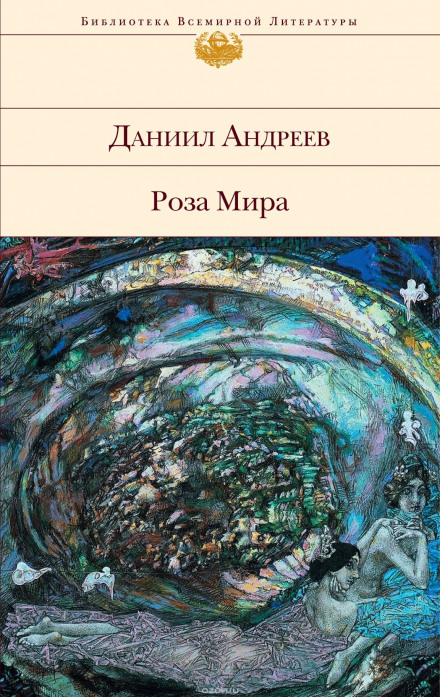
The Rose of the World
34 hrs. 23 min.
Description
“Rose of the World” is a religious-philosophical work by D. L. Andreev, based on mystical insights received in Vladimir prison and written in October 1958.
For a long time the book was distributed through “samizdat” (unauthorized self-publishing), and officially, for the first time, it was published in 1991. The attitude toward the book is ambiguous. Many consider it one of the most fantastic and unexpected works in Russian philosophy and literature. By the definition of the author himself, “The Rose of the World is the coming Church of All-Christians of the last centuries, uniting within itself the churches of the past and connecting with them on the basis of a free union with all religions of a bright direction. In this sense, the Rose of the World is interreligious or panreligious. Its main task is to save the largest possible number of human souls and to keep them distant from the danger of spiritual enslavement by the coming anti-God.”
In the introductory first book, the author describes the historical context in which the treatise was written, its aims and objectives, the attitude of the “Rose of the World” toward science, art, and religions, and presents its epistemology. In the second book, the writer introduces a general system of ideas and terms necessary to understand the rest of the text. Books three through six are devoted to a panorama of the layered planetary cosmos of Earth (Shadanakar). The picture created here (excluding the chapter “Logos of Shadanakar”) has a static character, preparing for the next five books, in which the meta-history of Russia is laid out and, in particular, the meta-historical meaning of the work of a number of the brightest figures of Russian culture. The concluding book considers historical prospects, specifies the possibilities associated with the coming of the era of the Rose of the World, and finally contains the eschatological part of the teaching.
For a long time the book was distributed through “samizdat” (unauthorized self-publishing), and officially, for the first time, it was published in 1991. The attitude toward the book is ambiguous. Many consider it one of the most fantastic and unexpected works in Russian philosophy and literature. By the definition of the author himself, “The Rose of the World is the coming Church of All-Christians of the last centuries, uniting within itself the churches of the past and connecting with them on the basis of a free union with all religions of a bright direction. In this sense, the Rose of the World is interreligious or panreligious. Its main task is to save the largest possible number of human souls and to keep them distant from the danger of spiritual enslavement by the coming anti-God.”
In the introductory first book, the author describes the historical context in which the treatise was written, its aims and objectives, the attitude of the “Rose of the World” toward science, art, and religions, and presents its epistemology. In the second book, the writer introduces a general system of ideas and terms necessary to understand the rest of the text. Books three through six are devoted to a panorama of the layered planetary cosmos of Earth (Shadanakar). The picture created here (excluding the chapter “Logos of Shadanakar”) has a static character, preparing for the next five books, in which the meta-history of Russia is laid out and, in particular, the meta-historical meaning of the work of a number of the brightest figures of Russian culture. The concluding book considers historical prospects, specifies the possibilities associated with the coming of the era of the Rose of the World, and finally contains the eschatological part of the teaching.
100%
1:13:30
01-1-roza
50:51
01-2-roza
57:44
01-3-roza
57:22
02-1-roza
57:19
02-2-roza
1:26:20
02-3-roza
31:36
03-1-roza
1:16:33
03-2-roza
53:09
03-3-roza
27:24
04-1-roza
43:38
04-2-roza
41:17
04-3-roza
31:16
05-1-roza
28:01
05-2-roza
1:05:27
05-3-roza
26:57
06-1-roza
1:06:47
06-2-roza
44:28
06-3-roza
57:31
07-1-roza
34:09
07-2-roza
22:47
07-3-roza
43:55
08-1-roza
32:53
08-2-roza
17:37
08-3-roza
20:53
08-4-roza
54:11
09-1-roza
18:12
09-2-roza
27:49
09-3-roza
29:55
09-4-roza
45:10
10-1-roza
48:11
10-2-roza
44:52
10-3-roza
38:19
10-4-roza
48:07
10-5-roza
41:25
11-1-roza
47:23
11-2-roza
2:10:40
11-3-roza
48:33
11-4-roza
1:19:14
12-1-roza
45:58
12-2-roza
58:21
12-3-roza
1:07:41
12-4-roza
25:03
12-5-roza
14:28
ks-roza
