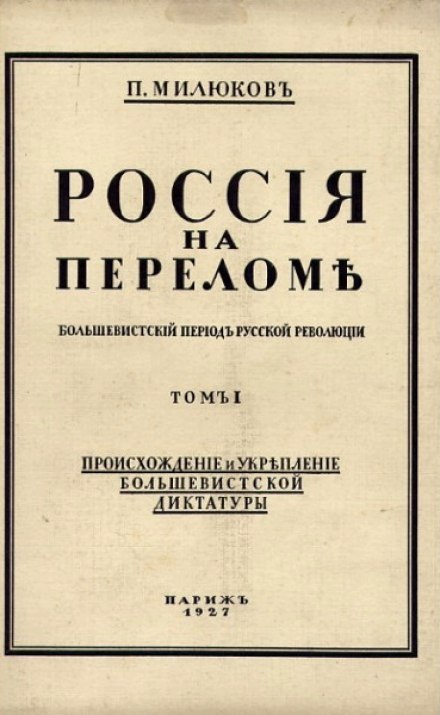
Russia at the Crossroads
47 min.
Language
Russian
Author
Pavel Milyukov
Author
Pavel Milyukov
Narrator
Vyacheslav Gerasimov
Narrator
Vyacheslav Gerasimov
Description
Milyukov viewed the October Revolution with hostility. All his efforts were aimed at creating a united front in the struggle against Soviet Russia. In the name of crushing the Bolsheviks, the leader of the Cadets in spring 1918 did not hesitate even to ally with yesterday’s opponents—namely, the Germans. He became an active participant in all major anti-Bolshevik initiatives: the creation of the Volunteer Army (the Army’s program declaration was written by him), foreign military intervention, and so on. A crucial part of Milyukov’s political activity was writing “The History of the Second Russian Revolution” (1918–1921).
In the autumn of 1918, Milyukov left Russia, first going to Romania, then to France and England. From 1921 he lived in Paris. His main work was developing a “new strategy” for fighting the Bolsheviks. By bringing together the “left” wing of the emigration in opposition to those who advocated armed struggle against Soviet power, Milyukov acknowledged certain achievements of that power (a republic, a federation of individual parts of the state, the liquidation of landed estates), expecting it to transform within the framework of the new economic policy and then ultimately collapse.
In France, Milyukov became the editor of the newspaper “The Latest News,” which gathered around it the best literary and journalistic forces of Russian abroad. He was a founder and chairman of the Society of Russian Writers and Journalists, the Club of Russian Writers and Scientists, the Committee for Aid to the Hungry in Russia (1921), and one of the organizers of the Russian People’s University. He lectured at the Sorbonne, at the College of Social Sciences, and at the Franco-Russian Institute. At the same time, Milyukov returned to scholarly work: he published a two-volume study “Russia at the Crossroads” (1927) on the events of the Civil War; he prepared for publication an expanded and revised edition of “Essays on the History of Russian Culture” (published 1930–1937), and others.
After Nazi Germany attacked the USSR, Milyukov closely followed the retreat of the Soviet army. In his last article, “The Truth About Bolshevism” (1942–1943), probably written after hearing the news of the defeat of the Germans at Stalingrad, he openly declared solidarity with the Russian people fighting the invaders.
In the autumn of 1918, Milyukov left Russia, first going to Romania, then to France and England. From 1921 he lived in Paris. His main work was developing a “new strategy” for fighting the Bolsheviks. By bringing together the “left” wing of the emigration in opposition to those who advocated armed struggle against Soviet power, Milyukov acknowledged certain achievements of that power (a republic, a federation of individual parts of the state, the liquidation of landed estates), expecting it to transform within the framework of the new economic policy and then ultimately collapse.
In France, Milyukov became the editor of the newspaper “The Latest News,” which gathered around it the best literary and journalistic forces of Russian abroad. He was a founder and chairman of the Society of Russian Writers and Journalists, the Club of Russian Writers and Scientists, the Committee for Aid to the Hungry in Russia (1921), and one of the organizers of the Russian People’s University. He lectured at the Sorbonne, at the College of Social Sciences, and at the Franco-Russian Institute. At the same time, Milyukov returned to scholarly work: he published a two-volume study “Russia at the Crossroads” (1927) on the events of the Civil War; he prepared for publication an expanded and revised edition of “Essays on the History of Russian Culture” (published 1930–1937), and others.
After Nazi Germany attacked the USSR, Milyukov closely followed the retreat of the Soviet army. In his last article, “The Truth About Bolshevism” (1942–1943), probably written after hearing the news of the defeat of the Germans at Stalingrad, he openly declared solidarity with the Russian people fighting the invaders.
100%
04:06
01-rossiya-na-perelomemp3
21:59
02-rossiya-na-perelomemp3
21:30
03-rossiya-na-perelomemp3
