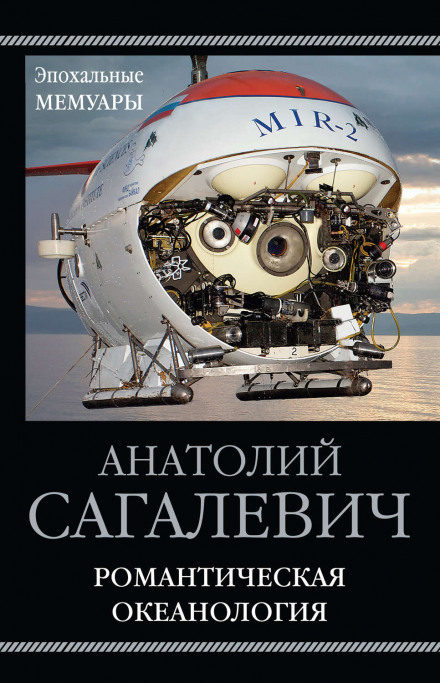
Romantic Oceanology
9 hrs. 29 min.
Language
Russian
Author
Anatoly Sagalevich
Author
Anatoly Sagalevich
Narrator
Anna Plotitsyna
Narrator
Anna Plotitsyna
Description
A NEW BOOK by the celebrated researcher of the deep seas, Hero of Russia, academician of the Russian Academy of Sciences, who took part in hundreds of the most complex scientific experiments on deep-sea manned vehicles and in filming popular films—including James Cameron’s “Titanic,” for which he suggested the very plot of the legendary film. Anatoly Sagalevich is not only the designer of practically all domestic scientific underwater vehicles, but also their first test pilot, creator of the art of controlling manned mini-submarines. He dived to different depths in almost all oceans, spending a total of more than 4,000 hours underwater, conquering slopes and peaks of underwater mountains, seeing what rift cracks—those that split the Earth’s crust—look like on the ocean floor, investigating fields of underwater volcanoes, and exploring sunken ships.
“Through the porthole I see the bow of the ‘Titanic’: it seems to rise up out of the sediment covering the bottom. Once smooth and gleaming with fresh paint, the hull, after many decades, is now covered with a thick layer of rust—sliding from top to bottom like icicles up to thirty centimeters long.”
“For the first time in history, a person saw the bottom of the Arctic Ocean at the geographic North Pole! Unfortunately, nothing outstanding: only a yellowish-brown sediment, even, without depressions or hills. Three of us sit down in front of the TV camera, and I report upstairs: ‘12 hours 11 minutes. The Mir-1 apparatus landed on the bottom of the ocean at the geographic North Pole at a depth of 4,261 meters.’”
“Through the porthole I see the bow of the ‘Titanic’: it seems to rise up out of the sediment covering the bottom. Once smooth and gleaming with fresh paint, the hull, after many decades, is now covered with a thick layer of rust—sliding from top to bottom like icicles up to thirty centimeters long.”
“For the first time in history, a person saw the bottom of the Arctic Ocean at the geographic North Pole! Unfortunately, nothing outstanding: only a yellowish-brown sediment, even, without depressions or hills. Three of us sit down in front of the TV camera, and I report upstairs: ‘12 hours 11 minutes. The Mir-1 apparatus landed on the bottom of the ocean at the geographic North Pole at a depth of 4,261 meters.’”
