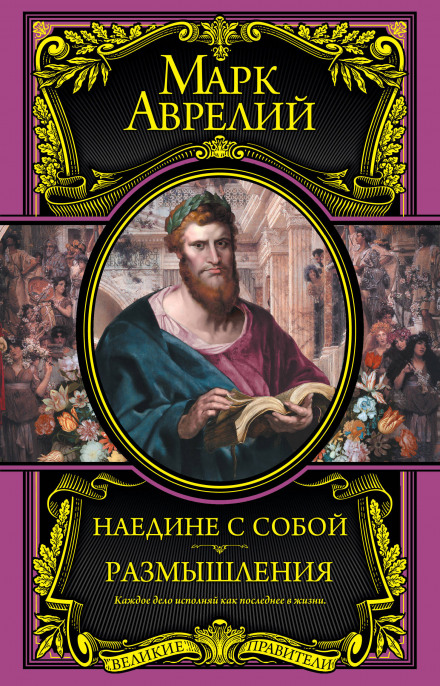
Meditations
3 hrs. 46 min.
Language
Russian
Author
Marcus Aurelius
Author
Marcus Aurelius
Narrator
Aleksey Kovalenok
Narrator
Aleksey Kovalenok
Description
A high appraisal of Marcus Aurelius’s reflections “To Oneself” as a work of moral self-awareness was given by S. Kotlyarevsky in his essay. And Marcus Aurelius himself was called by him a member of the “upper city” of human culture.
Read on...
Apparently, the emperor did not intend his personal moralistic diary for publication. He is mainly preoccupied with the problems of duty and death. Again and again he reminds himself of the need not to give in to hatred or anger, despite the vile deeds and mistakes of those around him. The deontological reflection of Marcus Aurelius is based on awareness of personal responsibility for the fates of a vast society being undermined from within by the decay of morals and from without by barbarian raids. In these difficult conditions, he tries to maintain the posture of a wise man and hold his inner equilibrium.
The philosophical views of the emperor are not particularly original. In the main points, they are a rethinking of Epictetus’s teaching: trying to remake the world to one’s own liking is pointless; one must accept fate without complaints; each lot is good in its own way. Marcus Aurelius’s religious feeling is akin to Neoplatonism and even Christianity (though under him the latter was persecuted). In the cosmos, he sees some purposefully ordered whole, governed by the universal mind (providence).
The philosophical views of the emperor are not particularly original. In the main points, they are a rethinking of Epictetus’s teaching: trying to remake the world to one’s own liking is pointless; one must accept fate without complaints; each lot is good in its own way. Marcus Aurelius’s religious feeling is akin to Neoplatonism and even Christianity (though under him the latter was persecuted). In the cosmos, he sees some purposefully ordered whole, governed by the universal mind (providence).
100%
1:02:01
1 Recorded Audio 2012-окт-20 06-35-36
1:05:15
2 Recorded Audio 2012-окт-20 08-55-15
45:33
3 Recorded Audio 2012-окт-20 11-25-48
53:22
4 Recorded Audio 2012-окт-21 11-41-42
