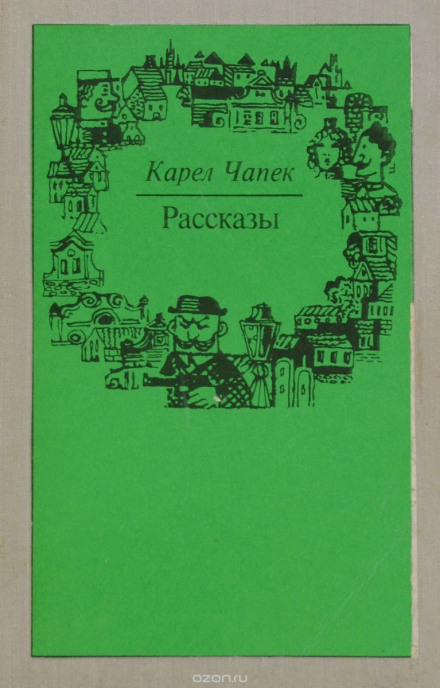
Stories
2 hrs. 7 min.
Language
Russian
Author
Karel Čapek
Author
Jaroslav Hašek
Narrator
Stanislav Fedosov
Narrator
Igor Taradaykin
Narrator
Alexander Kuritsyn
Narrator
Vladimir Antonik
Description
The period from 1918 to 1939 witnessed an unprecedented flourishing of Czech literature. The founding of the independent state of Czechoslovakia freed literary creativity from the previously characteristic moralizing spirit and allowed it to perform its original aesthetic function. It was precisely at this time that such outstanding authors appeared as Karel Čapek and Jaroslav Hašek.
Karel Čapek (January 9, 1890 — December 25, 1938) was one of the most famous Czech writers of the 20th century—a prose writer and playwright, a nominee for the Nobel Prize in 1936. Čapek’s literary debut took place in 1912: together with his brother Josef, he published the book of short stories “The Garden of Krakatit.” Worldwide fame came to the writer after his staging of the play “R.U.R.” about a machine revolt. Čapek introduced humanoid mechanisms into his plays and named them “labors” (from the Latin word “labor” — “work”). But the author disliked this name, and after discussing it with his brother he decided to call the mechanisms by a Czech word with a similar meaning: “work” in Czech sounds like “prace,” and the word “robota” means forced labor and any kind of compulsory work.
Together with his brother, Čapek wrote several other plays: “From the Life of Insects,” “Adam, the Creator,” “The Macroopulus Remedy,” “The White Disease,” and “The Mother” (the last two were created in the late 1930s and were imbued with anti-fascist pathos).
Above all, Čapek is known as a science-fiction writer and a subtle satirist. Among his most popular works are the novels “The Absolute Factory,” “Krakatit,” “The Gordubál,” “The Weather of the Year,” “Normal Life,” and “War with the Salamanders” (the last is considered the pinnacle of Čapek’s work).
Throughout his life, Karel Čapek was a committed humanist and held anti-fascist views. In addition to works of fiction, his pen produced a multi-volume biography of Tomas Garrigue Masaryk, the first president of the independent Czechoslovak Republic, a former personal friend of the writer. The biography is written in the form of instructive conversations, the main themes of which are politics and state structure.
Jaroslav Hašek (April 30, 1883 — January 3, 1923) had an interesting life. In his youth, he walked on foot across the entire Austro-Hungarian Empire, and partly even neighboring countries. This unusual journey provided priceless material for the writer’s early works: starting in the early 1900s, he began appearing in print with travel sketches, short stories, and humorous pieces. In 1921–1923 Hašek published the novel “The Adventures of the Good Soldier Švejk During the World War,” which brought him worldwide fame and was later translated into 60 languages.
The novel “The Adventures of the Good Soldier Švejk” caused enormous public resonance (at one time, even soldiers of the Czechoslovak army were forbidden to read this book) and had a huge influence on world literature. Among the best-known interpretations of the work, it’s worth mentioning the stage adaptation by B. Brecht and the novel “Catch-22” by J. Heller, in which grotesquely exaggerated depictions of war are accompanied by black humor and fantastic inventions.
Karel Čapek (January 9, 1890 — December 25, 1938) was one of the most famous Czech writers of the 20th century—a prose writer and playwright, a nominee for the Nobel Prize in 1936. Čapek’s literary debut took place in 1912: together with his brother Josef, he published the book of short stories “The Garden of Krakatit.” Worldwide fame came to the writer after his staging of the play “R.U.R.” about a machine revolt. Čapek introduced humanoid mechanisms into his plays and named them “labors” (from the Latin word “labor” — “work”). But the author disliked this name, and after discussing it with his brother he decided to call the mechanisms by a Czech word with a similar meaning: “work” in Czech sounds like “prace,” and the word “robota” means forced labor and any kind of compulsory work.
Together with his brother, Čapek wrote several other plays: “From the Life of Insects,” “Adam, the Creator,” “The Macroopulus Remedy,” “The White Disease,” and “The Mother” (the last two were created in the late 1930s and were imbued with anti-fascist pathos).
Above all, Čapek is known as a science-fiction writer and a subtle satirist. Among his most popular works are the novels “The Absolute Factory,” “Krakatit,” “The Gordubál,” “The Weather of the Year,” “Normal Life,” and “War with the Salamanders” (the last is considered the pinnacle of Čapek’s work).
Throughout his life, Karel Čapek was a committed humanist and held anti-fascist views. In addition to works of fiction, his pen produced a multi-volume biography of Tomas Garrigue Masaryk, the first president of the independent Czechoslovak Republic, a former personal friend of the writer. The biography is written in the form of instructive conversations, the main themes of which are politics and state structure.
Jaroslav Hašek (April 30, 1883 — January 3, 1923) had an interesting life. In his youth, he walked on foot across the entire Austro-Hungarian Empire, and partly even neighboring countries. This unusual journey provided priceless material for the writer’s early works: starting in the early 1900s, he began appearing in print with travel sketches, short stories, and humorous pieces. In 1921–1923 Hašek published the novel “The Adventures of the Good Soldier Švejk During the World War,” which brought him worldwide fame and was later translated into 60 languages.
The novel “The Adventures of the Good Soldier Švejk” caused enormous public resonance (at one time, even soldiers of the Czechoslovak army were forbidden to read this book) and had a huge influence on world literature. Among the best-known interpretations of the work, it’s worth mentioning the stage adaptation by B. Brecht and the novel “Catch-22” by J. Heller, in which grotesquely exaggerated depictions of war are accompanied by black humor and fantastic inventions.
Contents:
Karel Čapek
01. The Fortune Teller (read by Stanislav Fedosov)
02. A Man and a Weapon (read by Igor Taradaykin)
03. On the Decline in Morals (read by Aleksandr Kuritsyn)
04. Paté (read by Aleksandr Kuritsyn)
05. Attempted Murder (read by Vladimir Antonik)
06. The Joys of Life (read by Stanislav Fedosov)
07. Shirts (read by Aleksandr Zharkov)
Jaroslav Hašek
08. Introduction
09. The Handkerchief of Batiste (read by Sergey Kazakov)
10. How Mr. Mazucha took revenge for dishonored marital honor (read by Dmitry Tarnovyer)
11. How I sewed a button onto my trousers (read by Dmitry Tarnovyer)
12. The Fifteenth Issue (read by Dmitry Tarnovyer)
13. The School of Provocateurs (read by Alexey Bagdasarov)
01. The Fortune Teller (read by Stanislav Fedosov)
02. A Man and a Weapon (read by Igor Taradaykin)
03. On the Decline in Morals (read by Aleksandr Kuritsyn)
04. Paté (read by Aleksandr Kuritsyn)
05. Attempted Murder (read by Vladimir Antonik)
06. The Joys of Life (read by Stanislav Fedosov)
07. Shirts (read by Aleksandr Zharkov)
Jaroslav Hašek
08. Introduction
09. The Handkerchief of Batiste (read by Sergey Kazakov)
10. How Mr. Mazucha took revenge for dishonored marital honor (read by Dmitry Tarnovyer)
11. How I sewed a button onto my trousers (read by Dmitry Tarnovyer)
12. The Fifteenth Issue (read by Dmitry Tarnovyer)
13. The School of Provocateurs (read by Alexey Bagdasarov)
100%
15:19
01-karel-chapek-gadalka-stanislav-fedosov
07:39
02-karel-chapek-muzhchina-i-oruzhie-igor-taradajjkin
13:48
03-karel-chapek-o-padenii-nravov-aleksandr-kuricyn
12:51
04-karel-chapek-pashtet-aleksandr-kuricyn
13:33
05-karel-chapek-pokushenie-na-ubijjstvo-vladimir-antonik
07:15
06-karel-chapek-radosti-zhizni-stanislav-fedosov
15:29
07-karel-chapek-rubashki-aleksandr-zharkov
01:58
08-jaroslav-gashek-vstuplenie
06:08
09-jaroslav-gashek-batistovyjj-platochek-sergejj-kazakov
05:01
10-jaroslav-gashek-kak-pan-mazukha-mstil-za-porugannuju-supruzheskuju-chest-dmitrijj-tarnover
07:41
11-jaroslav-gashek-kak-ja-prishival-pugovicu-k-brjukam-dmitrijj-tarnover
05:35
12-jaroslav-gashek-pjatnadcatyjj-nomer-dmitrijj-tarnover
15:16
13-jaroslav-gashek-shkola-provokatorov-aleksejj-bagdasarov
