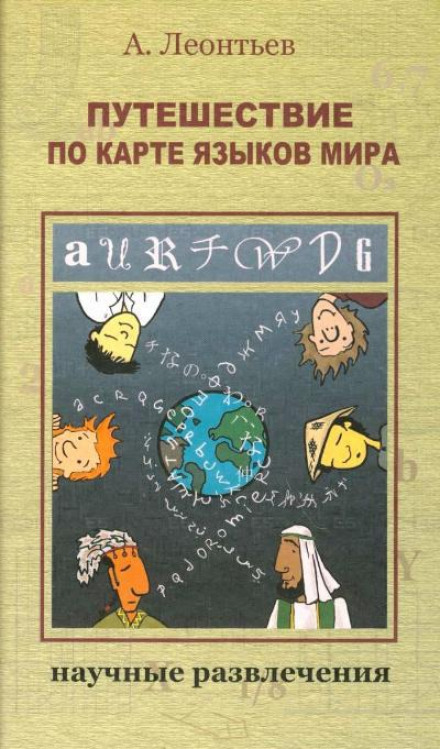
Journey Across the Map of the World's Languages
3 hrs. 50 min.
Language
Russian
Author
Alexey Leontyev
Author
Alexey Leontyev
Narrator
Vyacheslav Gerasimov
Narrator
Vyacheslav Gerasimov
Description
Do you want to know when the Chukchi «finger-count»? And how do people count in New Guinea? Why does the author’s surname sound like Reontiefu in Japanese, and where are the longest words found? How is the Russian language related to Bengali and Persian? Where do words travel, and why are there hundreds of them in some languages and hundreds of thousands in others?
In academician Alexei Leontiev’s book «Journey Across the Map of the World's Languages», you will find answers to these and many other equally interesting questions.
The works devoted to the science that studies language—linguistics, its past, present, and future—are written vividly and quite accessibly, and will make the reader think about many things they may previously have had no idea about.
In academician Alexei Leontiev’s book «Journey Across the Map of the World's Languages», you will find answers to these and many other equally interesting questions.
The works devoted to the science that studies language—linguistics, its past, present, and future—are written vividly and quite accessibly, and will make the reader think about many things they may previously have had no idea about.
Contents:
From the editor
Secrets of language and riddles of languages
Author’s preface
Language and the science of it
What is language?
Linguistics — the science of language
Languages of the world
Language families
Map of the world’s languages
Languages move toward each other
Languages lend each other a hand
Ask — we answer
Grammatical features of different languages
Language and society
How we speak
On the origin of language
Why can we speak?
Human, society, personality
How do we speak?
Speech and types of speech
Do you know Russian?
Language and the human mind
Author’s preface
Substitutes for language
To be or not to be semiotics?
A sign? A system?
Language and semiotics
Closest «relatives»
The story of Mr. Zhi
The easiest way to learn Eskimo
Language will get you to Kyiv
Guide to the radio receiver
Feelings — Eyes — Moon
From a bird’s-eye view
What did seafarers learn?
Journey Across the Map of the World's Languages
Author’s preface
From the author
Unlike brothers
In the name of science
The family tree of languages and how it is compiled
So what kind of map is this?
The Indo-Europeans again
Afrasian (Afro-Asiatic) languages
Uralic languages
Altaic languages
Caucasian languages
Chukotko-Kamchatkan and other languages of Siberia and the Far East
Chinese and its neighbors
Austroasiatic languages
Dravidian and other languages of continental Asia
Languages of the Pacific Ocean
Don’t go to Africa…
What’s new about the Indians
Let’s sum up
The sounds we choose
Misha, Mkrtich, and Maui
Ah, time, time!
A little bit about the phoneme
Sounds in packaging, or what stress is
Are there languages without grammar?
Which way do our words decline?
Can a verb be declined?
Mother sees daughter
Predicativity is needed, uncle!
Three people do something to two, or accountant-language
Is «we» many «I»s?
«Child gender» and «floating class»
Just a little about verbal aspect
About the adjective and its relatives
«…From the speaker downward or toward the doors…»
The «difficult» Russian language
What is this called?
«Primitive» languages in a crooked mirror and in reality
How many words does a person need?
Blue or green?
Right to left? Left to right? Top to bottom?
Or maybe — some other way?
III. 3. Three.
Human + word = believe
The birth of letters
Biography of your writing
A language that is not spoken
Can one stand in a non-Russian way?
What is etiquette?
What does hare mean?
Conclusion
Linguistics of the 21st century
Secrets of language and riddles of languages
Author’s preface
Language and the science of it
What is language?
Linguistics — the science of language
Languages of the world
Language families
Map of the world’s languages
Languages move toward each other
Languages lend each other a hand
Ask — we answer
Grammatical features of different languages
Language and society
How we speak
On the origin of language
Why can we speak?
Human, society, personality
How do we speak?
Speech and types of speech
Do you know Russian?
Language and the human mind
Author’s preface
Substitutes for language
To be or not to be semiotics?
A sign? A system?
Language and semiotics
Closest «relatives»
The story of Mr. Zhi
The easiest way to learn Eskimo
Language will get you to Kyiv
Guide to the radio receiver
Feelings — Eyes — Moon
From a bird’s-eye view
What did seafarers learn?
Journey Across the Map of the World's Languages
Author’s preface
From the author
Unlike brothers
In the name of science
The family tree of languages and how it is compiled
So what kind of map is this?
The Indo-Europeans again
Afrasian (Afro-Asiatic) languages
Uralic languages
Altaic languages
Caucasian languages
Chukotko-Kamchatkan and other languages of Siberia and the Far East
Chinese and its neighbors
Austroasiatic languages
Dravidian and other languages of continental Asia
Languages of the Pacific Ocean
Don’t go to Africa…
What’s new about the Indians
Let’s sum up
The sounds we choose
Misha, Mkrtich, and Maui
Ah, time, time!
A little bit about the phoneme
Sounds in packaging, or what stress is
Are there languages without grammar?
Which way do our words decline?
Can a verb be declined?
Mother sees daughter
Predicativity is needed, uncle!
Three people do something to two, or accountant-language
Is «we» many «I»s?
«Child gender» and «floating class»
Just a little about verbal aspect
About the adjective and its relatives
«…From the speaker downward or toward the doors…»
The «difficult» Russian language
What is this called?
«Primitive» languages in a crooked mirror and in reality
How many words does a person need?
Blue or green?
Right to left? Left to right? Top to bottom?
Or maybe — some other way?
III. 3. Three.
Human + word = believe
The birth of letters
Biography of your writing
A language that is not spoken
Can one stand in a non-Russian way?
What is etiquette?
What does hare mean?
Conclusion
Linguistics of the 21st century
100%
02:43
00-01-ot-avtora
17:22
01-01-misha-mkrtich-i-maui
19:46
01-02-ah-fremya-fremya
15:44
01-03-zvuki-v-upakovke-ili-chto-takoe-udarenie
13:34
02-01-kuda-sklonyayutsya-nashi-slova
05:33
02-02-nelzya-li-prosklonyat-glagol
06:01
02-03-mat-vidit-doch
16:00
02-04-nuzhna-predikativnost-dyadya
15:05
02-05-troe-delayut-chto-to-s-dvoimi-ili-yazyk-buhgaltera
08:28
02-06-my-mnogo-ya
09:20
02-07-detskiy-rod-i-plavayuschiy-klass
02:51
02-08-sovsem-nemnozhko-o-vide-glagolov
07:26
02-09-o-prilagatelnom-i-ego-rodstvennikah
13:49
02-10-ot-govoryaschego-na-niz-ili-k-dveryam
05:17
02-11-trudnyy-russkiy-yazyk
12:43
03-01-pervobytnye-yazyki-v-krivom-zerkale-i-na-samom-dele
10:14
03-02-skolko-slov-nuzhno-cheloveku
08:55
03-03-siniy-ili-zelenyy
06:19
04-01-mozhno-li-stoyat-ne-po-russki
03:57
04-02-chto-takoe-etiket
03:04
04-03-chto-oznachaet-zayats
13:00
05-01-indo-evropeyskaya-semya
02:28
05-02-dva-iz-pyatnadtsati
03:53
05-03-yazyki-vstavlyayuschie-i-yazyki-izoliruyuschie
07:10
06-zaklyuchenie
