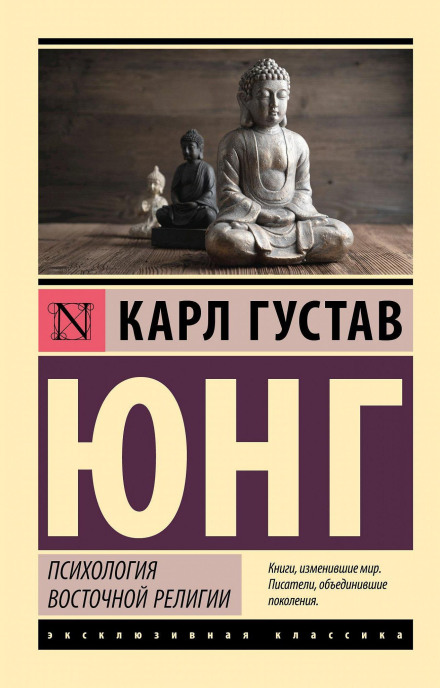
Psychology and Eastern Religion
5 hrs. 32 min.
Language
Russian
Author
Jung Carl
Author
Jung Carl
Narrator
Vladislav Gorbylyev
Narrator
Vladislav Gorbylyev
Description
Carl Gustav Jung, the founder of analytical psychology, turns his gaze to the East: in this collection, he examines the psychological aspects of Buddhism and Hinduism, drawing in particular on the Tibetan "Book of the Great Liberation."
Carl Gustav Jung (1875–1961) — a Swiss psychologist and psychotherapist, philosopher, sociologist, and cultural scholar; one of the greatest thinkers of the 20th century, a student of Sigmund Freud, the founder of analytical psychology and psychotherapy, as well as the creator and president of the Swiss Society for Practical Psychology.
The theme of religion occupied a special place in Jung’s works. This collection includes texts in which he explores the psychological content of philosophical doctrines of various currents of Buddhism and Hinduism, including, in particular, with reference to the Tibetan "Book of the Great Liberation," reflects on why yoga became so in demand in the West, compares the Eastern and Western understandings of freedom and holiness, and analyzes the psychology of Eastern meditative practice.
Carl Gustav Jung (1875–1961) — a Swiss psychologist and psychotherapist, philosopher, sociologist, and cultural scholar; one of the greatest thinkers of the 20th century, a student of Sigmund Freud, the founder of analytical psychology and psychotherapy, as well as the creator and president of the Swiss Society for Practical Psychology.
The theme of religion occupied a special place in Jung’s works. This collection includes texts in which he explores the psychological content of philosophical doctrines of various currents of Buddhism and Hinduism, including, in particular, with reference to the Tibetan "Book of the Great Liberation," reflects on why yoga became so in demand in the West, compares the Eastern and Western understandings of freedom and holiness, and analyzes the psychology of Eastern meditative practice.
100%
51:51
Психология восточной религии 01
37:49
Психология восточной религии 02
44:33
Психология восточной религии 03
24:08
Психология восточной религии 04
47:01
Психология восточной религии 05
47:03
Психология восточной религии 06
28:19
Психология восточной религии 07
51:48
Психология восточной религии 08
