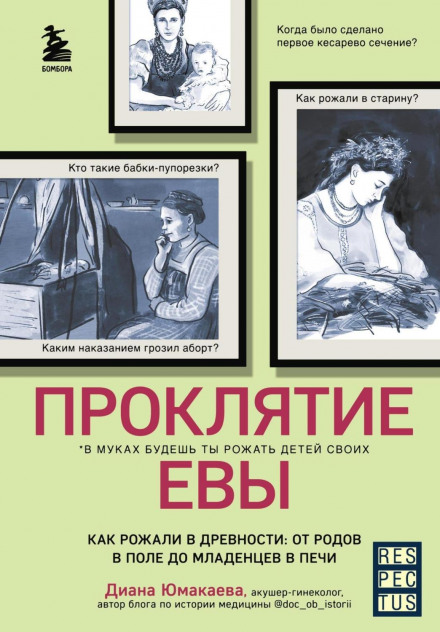
Eve's Curse: How People Gave Birth in Ancient Times: From Birthing in the Field to Babies in the Oven
7 hrs. 45 min.
Language
Russian
Author
Diana Yumakaeva
Author
Diana Yumakaeva
Narrator
Dabrishyute Dina
Narrator
Dabrishyute Dina
Description
Today medicine ensures women the safest possible childbirths, which can lead to problems only in isolated cases. But in ancient times, this wasn’t the case. Women understood that childbirth was a great danger for them. Many were afraid to give birth because they knew that due to blood loss or infections, almost every second mother died. Diana Yumakaeva’s book, an obstetrician-gynecologist and author of a medical history blog, will take you back to an era when childbirth and pregnancy were surrounded by many superstitions.
INTERESTING FACTS THAT WILL SURPRISE YOU:
— Not in all tribes were births an intimate matter. In the aboriginal tribes of the Sandwich Islands, it was customary to gather the public. And spectators could comment on what was happening and give advice to the laboring woman.
— For centuries, women preferred to give birth in a wide variety of positions. For example, ancient Persian women arranged a small pyramid from stones that they would rest their hands and knees against—this is how childbirth took place.
— In Holland, the birthing chair was an obligatory part of a bride’s dowry.
— To avoid infertility, girls from aristocratic families wore a belt decorated with gold patterns in the shape of cowrie shells—symbols of female genital organs.
— Among Indigenous Americans, a woman was expected to spend twenty days after giving birth in her own room in absolute darkness. Sunlight was not supposed to touch the skin of the mother or the child. After the allotted time, a celebration was held in the house.
— Hippocrates “blamed” the womb for all troubles. In the “Corpus of Hippocrates,” the diagnosis “wandering womb” appears for the first time. It was believed that it could freely travel through a woman’s body.
— The first doctors in Rome were captured Greeks who had the status of slaves. Each provided citizen was required to have a doctor-slave in their home.
INTERESTING FACTS THAT WILL SURPRISE YOU:
— Not in all tribes were births an intimate matter. In the aboriginal tribes of the Sandwich Islands, it was customary to gather the public. And spectators could comment on what was happening and give advice to the laboring woman.
— For centuries, women preferred to give birth in a wide variety of positions. For example, ancient Persian women arranged a small pyramid from stones that they would rest their hands and knees against—this is how childbirth took place.
— In Holland, the birthing chair was an obligatory part of a bride’s dowry.
— To avoid infertility, girls from aristocratic families wore a belt decorated with gold patterns in the shape of cowrie shells—symbols of female genital organs.
— Among Indigenous Americans, a woman was expected to spend twenty days after giving birth in her own room in absolute darkness. Sunlight was not supposed to touch the skin of the mother or the child. After the allotted time, a celebration was held in the house.
— Hippocrates “blamed” the womb for all troubles. In the “Corpus of Hippocrates,” the diagnosis “wandering womb” appears for the first time. It was believed that it could freely travel through a woman’s body.
— The first doctors in Rome were captured Greeks who had the status of slaves. Each provided citizen was required to have a doctor-slave in their home.
100%
02:15
Проклятие Евы. Как рожали в древности_ от родов в поле до младенцев в печи - 0 - Вступление
10:21
Проклятие Евы. Как рожали в древности_ от родов в поле до младенцев в печи - 1 - Часть I. Роды в истории медицины. Глава 1. Первые люди
43:58
Проклятие Евы. Как рожали в древности_ от родов в поле до младенцев в печи - 2 - Глава 2. Древние цивилизации
42:45
Проклятие Евы. Как рожали в древности_ от родов в поле до младенцев в печи - 3 - Глава 3. Акушерство в Европе_ от Средних веков к Новому времени
1:09:42
Проклятие Евы. Как рожали в древности_ от родов в поле до младенцев в печи - 4 - Глава 4. Что происходило на Руси_
42:48
Проклятие Евы. Как рожали в древности_ от родов в поле до младенцев в печи - 5 - Глава 5. Женское медицинское образование
07:07
Проклятие Евы. Как рожали в древности_ от родов в поле до младенцев в печи - 6 - Часть II. Основные акушерские открытия. Глава 1. Акушерские щипцы
15:01
Проклятие Евы. Как рожали в древности_ от родов в поле до младенцев в печи - 7 - Глава 2. Кесарево сечение
42:56
Проклятие Евы. Как рожали в древности_ от родов в поле до младенцев в печи - 8 - Глава 3. Анестезия в родах
25:03
Проклятие Евы. Как рожали в древности_ от родов в поле до младенцев в печи - 9 - Глава 4. Антисептика в родах
27:49
Проклятие Евы. Как рожали в древности_ от родов в поле до младенцев в печи - 10 - Глава 5. История аборта
14:37
Проклятие Евы. Как рожали в древности_ от родов в поле до младенцев в печи - 11 - Глава 6. История появления теста на беременность
21:36
Проклятие Евы. Как рожали в древности_ от родов в поле до младенцев в печи - 12 - Глава 7. Переливание крови
36:58
Проклятие Евы. Как рожали в древности_ от родов в поле до младенцев в печи - 13 - Глава 8. История грудного вскармливания
08:11
Проклятие Евы. Как рожали в древности_ от родов в поле до младенцев в печи - 14 - Часть III. Казуистические случаи, связанные с акушерством, материнством и детством. Глава 1. Джин Тирни
04:06
Проклятие Евы. Как рожали в древности_ от родов в поле до младенцев в печи - 15 - Глава 2. Инес Рамирес
06:44
Проклятие Евы. Как рожали в древности_ от родов в поле до младенцев в печи - 16 - Глава 3. Агриппина Абрикосова
10:19
Проклятие Евы. Как рожали в древности_ от родов в поле до младенцев в печи - 17 - Глава 4. Талидомидовая трагедия
02:51
Проклятие Евы. Как рожали в древности_ от родов в поле до младенцев в печи - 18 - Глава 5. «Лина Медина — самая молодая мать»
09:39
Проклятие Евы. Как рожали в древности_ от родов в поле до младенцев в печи - 19 - Глава 6. Александра Федоровна Романова
08:29
Проклятие Евы. Как рожали в древности_ от родов в поле до младенцев в печи - 20 - Глава 7. Роберт Эдвардс, Патрик Стрептоу и Луиза Браун
04:03
Проклятие Евы. Как рожали в древности_ от родов в поле до младенцев в печи - 21 - Глава 8. Шестерняшки Уолтон
06:20
Проклятие Евы. Как рожали в древности_ от родов в поле до младенцев в печи - 22 - Глава 9. Овечка Долли
01:41
Проклятие Евы. Как рожали в древности_ от родов в поле до младенцев в печи - 23 - Вместо послесловия
