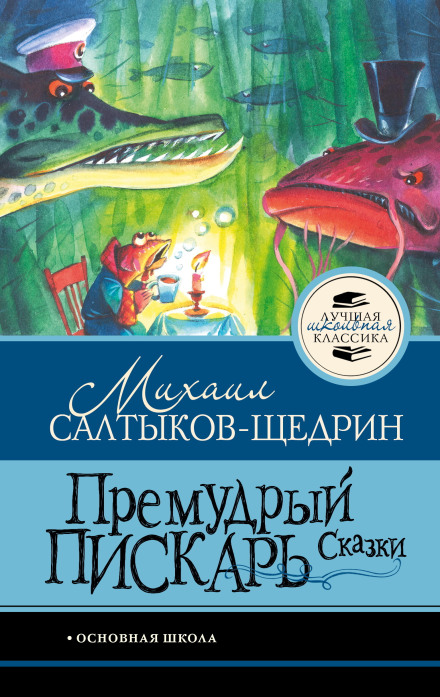
The Wise Gudgeon. Tales
2 hrs. 40 min.
Language
Russian
Author
Mikhail Saltykov-Shchedrin
Author
Mikhail Saltykov-Shchedrin
Narrator
Konstantin Korolkov
Narrator
Filipp Matveev-Vitovsky
Description
Do you know how an ordinary peasant managed to feed two generals who found themselves on an uninhabited island? Or why “the wise gudgeon” was considered the cleverest, while the “wild landowner” was deemed the most foolish?
Saltykov-Shchedrin — the acclaimed satirist and editor of journals — in the last years of his life wrote a cycle of fairy tales, where behind animal-like images and seemingly everyday plots lies a sharp, precise mockery of the vices of an entire era.
Mikhail Saltykov-Shchedrin (1826–1889) — a well-known Russian writer, satirist, journalist, editor of journals, and a government official. As a young man, he studied at the Tsarskoye Selo Lyceum, where his interest in literature and writing poetry first became evident. Later, the future author moved away from poetry and focused on prose.
It was in his mature years that Saltykov-Shchedrin turned to the fairy-tale genre. Using a fairy-tale form, he sharpened satire and transformed parody of officials, fashionable literary figures, and other typical people of his time into an especially expressive comedy. The collection includes works by a classic of Russian literature, among them “The Wise Gudgeon,” “The Tale of How One Peasant Fed Two Generals,” “The Wild Landowner,” “The Bear as Governor,” and others.
Saltykov-Shchedrin — the acclaimed satirist and editor of journals — in the last years of his life wrote a cycle of fairy tales, where behind animal-like images and seemingly everyday plots lies a sharp, precise mockery of the vices of an entire era.
Mikhail Saltykov-Shchedrin (1826–1889) — a well-known Russian writer, satirist, journalist, editor of journals, and a government official. As a young man, he studied at the Tsarskoye Selo Lyceum, where his interest in literature and writing poetry first became evident. Later, the future author moved away from poetry and focused on prose.
It was in his mature years that Saltykov-Shchedrin turned to the fairy-tale genre. Using a fairy-tale form, he sharpened satire and transformed parody of officials, fashionable literary figures, and other typical people of his time into an especially expressive comedy. The collection includes works by a classic of Russian literature, among them “The Wise Gudgeon,” “The Tale of How One Peasant Fed Two Generals,” “The Wild Landowner,” “The Bear as Governor,” and others.
100%
12:50
Премудрый пискарь. Сказки 01
15:35
Премудрый пискарь. Сказки 02
18:05
Премудрый пискарь. Сказки 03
12:17
Премудрый пискарь. Сказки 04
13:55
Премудрый пискарь. Сказки 05
25:02
Премудрый пискарь. Сказки 06
20:53
Премудрый пискарь. Сказки 07
23:04
Премудрый пискарь. Сказки 08
18:38
Премудрый пискарь. Сказки 09
