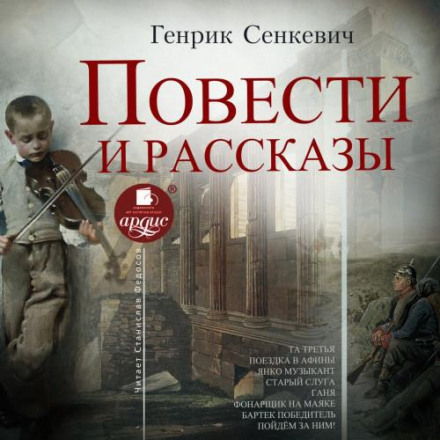
Novellas and Stories
14 hrs. 24 min.
Language
Russian
Author
Henryk Sienkiewicz
Author
Henryk Sienkiewicz
Narrator
Stanislav Fedosov
Narrator
Stanislav Fedosov
Description
Henryk Sienkiewicz, the Polish writer, author of historical novels, recipient of the 1905 Nobel Prize in Literature, belonged to the circle of outstanding Polish realists of the 19th century.
In the early novellas and stories included in this collection, we can see the author’s interest in themes of the fading of patriarchal life (“The Old Servant,” “Hania”) and the fate of the peasantry (“Janko the Musician”). The latter became the most popular of Sienkiewicz’s stories in Russia: only until 1917 it was published about 40 times, translated by V. G. Korolenko. The story “The Lighthouse Keeper” tells of longing for one’s homeland of a Pole abandoned abroad—a participant in the uprising of 1830–31. In the story “Bartek the Winner,” bitter satire speaks of Germanization and mocking of Polish peasants in the part of Poland under Prussian rule.
Many of the themes from Sienkiewicz’s novels are present in the earlier stories he wrote, so “That Third One” precedes the novels about modern times.
In the early novellas and stories included in this collection, we can see the author’s interest in themes of the fading of patriarchal life (“The Old Servant,” “Hania”) and the fate of the peasantry (“Janko the Musician”). The latter became the most popular of Sienkiewicz’s stories in Russia: only until 1917 it was published about 40 times, translated by V. G. Korolenko. The story “The Lighthouse Keeper” tells of longing for one’s homeland of a Pole abandoned abroad—a participant in the uprising of 1830–31. In the story “Bartek the Winner,” bitter satire speaks of Germanization and mocking of Polish peasants in the part of Poland under Prussian rule.
Many of the themes from Sienkiewicz’s novels are present in the earlier stories he wrote, so “That Third One” precedes the novels about modern times.
