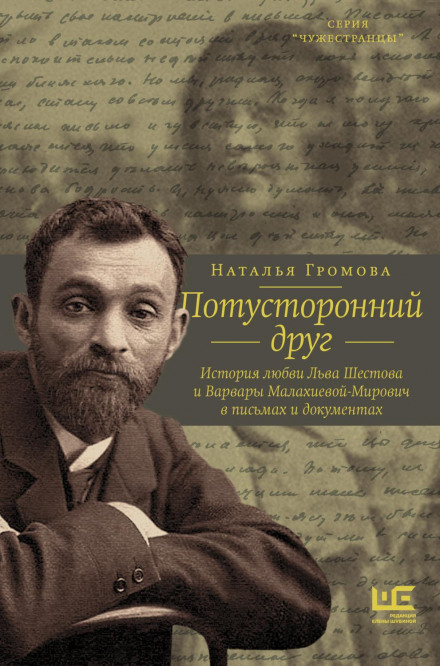
The Other-Worldly Friend. The Love Story of Lev Shestov and Varvara Malakhieva-Mirovich in Letters and Documents
13 hrs. 6 min.
Language
Russian
Author
Natalia Gromova
Author
Natalia Gromova
Narrator
Natalya Gromova
Narrator
Natalya Gromova
Description
A novel by the philosopher Lev Shestov and the poetess Varvara Malakhieva-Mirovich unfolded within the world of literature—conversations about Shakespeare, Kant, Nietzsche, and Dostoevsky—and it remained that way in each other’s letters. The story of love for Varvara Grigorievna, and the difficult relationship with her sister Anastasia, becomes a kind of prologue to Shestov’s "philosophy of tragedy" and sheds light on what propelled him toward existentialism—precisely about this blank spot in the philosopher’s biography the historian and prose writer Natalya Gromova tells in her new book "An Otherworldly Friend."
"I dreamed today of L. I. (Shestov). In he entered, young, quick, joyful. In his hands was a huge bouquet of flowers. He placed it before me with a radiant bashful smile. Fourteen years have passed since I saw her for the last time. Ten years have passed since the last letter. Doesn’t this dream mean that he has already crossed over—perhaps in the very night—over that line where there is no more old age, no conventions and barriers of everyday human life, no Paris, no Moscow. And there is no separation." From Varvara Malakhieva-Mirovich’s diary.
"I dreamed today of L. I. (Shestov). In he entered, young, quick, joyful. In his hands was a huge bouquet of flowers. He placed it before me with a radiant bashful smile. Fourteen years have passed since I saw her for the last time. Ten years have passed since the last letter. Doesn’t this dream mean that he has already crossed over—perhaps in the very night—over that line where there is no more old age, no conventions and barriers of everyday human life, no Paris, no Moscow. And there is no separation." From Varvara Malakhieva-Mirovich’s diary.
