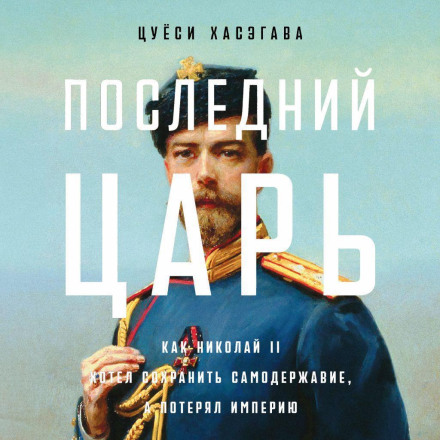
The Last Tsar: How Nicholas II Wanted to Preserve Autocracy but Lost an Empire
15 hrs. 11 min.
Language
Russian
Author
Tsuyoshi Hasegawa
Author
Tsuyoshi Hasegawa
Narrator
Oleg Tomilin
Narrator
Oleg Tomilin
Description
The fall of the House of Romanov became one of the most dramatic pages of the 20th century. Tsar Nicholas II’s abdication set in motion a chain of events that overturned not only Russia’s fate, but the balance of power across the entire Eastern Hemisphere. It is often argued that the weakening of the monarchy, the growth of the revolutionary movement, and the Bolsheviks’ victory were predetermined. However, the author shows that this was not fate, but the result of administrative errors and unwavering devotion to autocracy.
Tsuyoshi Hasegawa, a professor of history at the University of California, explains how Nicholas II’s refusal to accept reforms brought the end of the monarchy closer. Remaining a captive to outdated notions of power and swayed by the influence of his wife and Rasputin, the emperor repeatedly missed chances to change the situation: to draw on the patriotic upsurge at the start of World War I and strengthen his position; to reorganize the state apparatus on the basis of popular representation; to unite the elite and mobilize the bureaucracy to defend the state; to create a “minister of trust” and strengthen the role of the cabinet. In that case, the dynasty might have lost some influence, but could have preserved itself.
Drawing on recently declassified archival materials, historical documents, the period’s polemical writing, and eyewitness accounts from contemporaries, Hasegawa reconstructs an almost minute-by-minute picture of Nicholas II’s abdication and the events that accompanied the February Revolution.
Tsuyoshi Hasegawa, a professor of history at the University of California, explains how Nicholas II’s refusal to accept reforms brought the end of the monarchy closer. Remaining a captive to outdated notions of power and swayed by the influence of his wife and Rasputin, the emperor repeatedly missed chances to change the situation: to draw on the patriotic upsurge at the start of World War I and strengthen his position; to reorganize the state apparatus on the basis of popular representation; to unite the elite and mobilize the bureaucracy to defend the state; to create a “minister of trust” and strengthen the role of the cabinet. In that case, the dynasty might have lost some influence, but could have preserved itself.
Drawing on recently declassified archival materials, historical documents, the period’s polemical writing, and eyewitness accounts from contemporaries, Hasegawa reconstructs an almost minute-by-minute picture of Nicholas II’s abdication and the events that accompanied the February Revolution.
