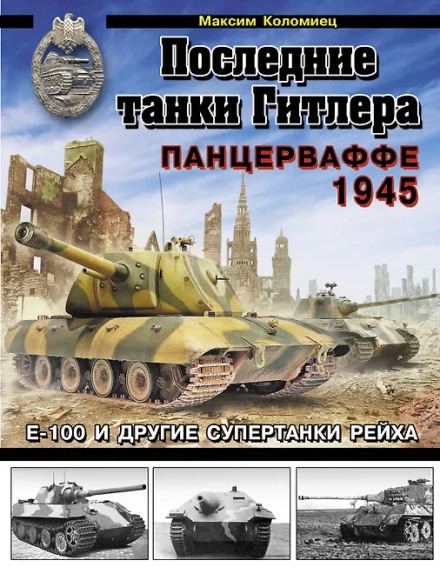
Hitler's Last Tanks. Panzerwaffe 1945
3 hrs. 4 min.
Language
Russian
Author
Maxim Kolomiyets
Author
Maxim Kolomiyets
Narrator
Oleg Chebotarev
Narrator
Oleg Chebotarev
Description
Even against the backdrop of the rapid advance of the Red Army and nonstop blows from Allied aviation in spring 1945, the industry of the Third Reich retained surprising resilience. It didn’t only continue producing weapons almost to the very end of the war, but also carried out work on new models of armored vehicles in parallel.
What tanks and self-propelled guns were supposed to be fielded according to the “emergency” plan of 1945–1946? What were they going to replace the Pz.III and Pz.IV that were rolling off the production lines with? How much did the installation of optical rangefinders, new sighting devices with a stabilized field of view, and a more powerful engine with injection fuel supply increase the potential of the upgraded “Royal Tiger”? How was the “Panther” Ausf. F supposed to differ besides the narrow Schmalturm turret, the 88-mm gun, and infrared night-vision equipment? Was there a planned transition from gasoline engines to diesel, wide implementation of recoil-less systems, and arming infantry and paratroopers with “small tank destroyers” (Panzerkleinzerstoerer) equipped with reactive weapons?
What were the “waffentragers,” and how dangerous could they become as enemies for our crews? And did real prospects exist to bring to series production “conceptual” E-series machines— including the 140-ton E-100 with 200-mm armor and a 174-mm gun, developed as an alternative to the famous “Maus”?
All these questions are answered by a new book by one of the leading researchers of armored vehicles, prepared based on documents from German archives. The edition is supplemented with hundreds of rare drawings, diagrams, and photographs.
What tanks and self-propelled guns were supposed to be fielded according to the “emergency” plan of 1945–1946? What were they going to replace the Pz.III and Pz.IV that were rolling off the production lines with? How much did the installation of optical rangefinders, new sighting devices with a stabilized field of view, and a more powerful engine with injection fuel supply increase the potential of the upgraded “Royal Tiger”? How was the “Panther” Ausf. F supposed to differ besides the narrow Schmalturm turret, the 88-mm gun, and infrared night-vision equipment? Was there a planned transition from gasoline engines to diesel, wide implementation of recoil-less systems, and arming infantry and paratroopers with “small tank destroyers” (Panzerkleinzerstoerer) equipped with reactive weapons?
What were the “waffentragers,” and how dangerous could they become as enemies for our crews? And did real prospects exist to bring to series production “conceptual” E-series machines— including the 140-ton E-100 with 200-mm armor and a 174-mm gun, developed as an alternative to the famous “Maus”?
All these questions are answered by a new book by one of the leading researchers of armored vehicles, prepared based on documents from German archives. The edition is supplemented with hundreds of rare drawings, diagrams, and photographs.
100%
02:03
Последние танки Гитлера. Панцерваффе 1945 01
26:11
Последние танки Гитлера. Панцерваффе 1945 02
12:59
Последние танки Гитлера. Панцерваффе 1945 03
11:03
Последние танки Гитлера. Панцерваффе 1945 04
23:47
Последние танки Гитлера. Панцерваффе 1945 05
10:32
Последние танки Гитлера. Панцерваффе 1945 06
30:12
Последние танки Гитлера. Панцерваффе 1945 07
19:17
Последние танки Гитлера. Панцерваффе 1945 08
03:17
Последние танки Гитлера. Панцерваффе 1945 09
10:45
Последние танки Гитлера. Панцерваффе 1945 10
25:23
Последние танки Гитлера. Панцерваффе 1945 11
09:24
Последние танки Гитлера. Панцерваффе 1945 12
