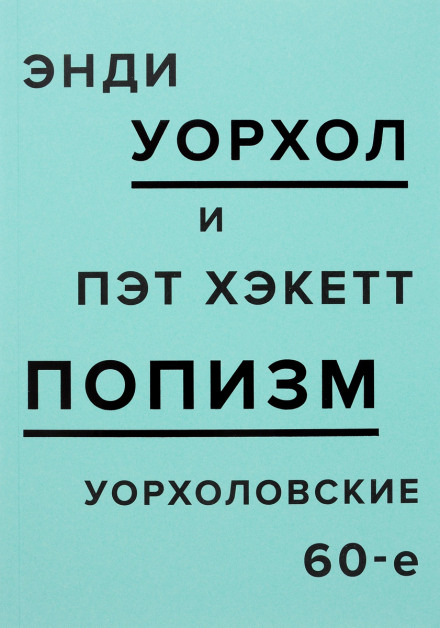
POPism: The Warhol Sixties
11 hrs. 24 min.
Language
Russian
Author
Andy Warhol
Author
Pat Hackett
Narrator
Kirill Petrov
Narrator
Kirill Petrov
Description
One of the key figures in the history of the pop-art movement and, more broadly, modern art, Andy Warhol, in his book “POPism,” describes the brightest decade of the last century—the 1960s.
The decade after which the world changed forever—never to be the same again. It was shaken by the arrival of the Beatles and the sexual revolution, by Gagarin’s flight and the Cuban coup, by the murder of John Kennedy and the landing of a man on the Moon.
With his characteristic audacity, humor, common sense, and dislike for pomp, Warhol tells what was happening before his eyes in those crazy years.
“POPism” isn’t about cultural processes in general and not even about an art period, but about the ever-valuable—and worthy of respect—ability and courage to make choices; about the logic of those choices; about how and on what basis to be—anywhere, anytime, the main thing is who.
In this unusually sentimental and touching book, Warhol recalls the best time of his life, reflects on why and how it began and чем and because of what it ended, recounts amusing or tragic episodes from his own life and from the lives of his “stars” and acquaintances.
As he builds his life like a collage from hundreds of characters (only in this book there are about seven hundred)—from little-known semi-criminal marginal folks from the streets of the Village to the cream of high society, millionaires, first ladies, and symbols of the era such as Bob Dylan and Ken Kesey—Warhol creates a unique space, similar to the famous American patchwork quilt: sweet and tasteless, a patchwork of “everything pop,” as he will put it in the book.
The decade after which the world changed forever—never to be the same again. It was shaken by the arrival of the Beatles and the sexual revolution, by Gagarin’s flight and the Cuban coup, by the murder of John Kennedy and the landing of a man on the Moon.
With his characteristic audacity, humor, common sense, and dislike for pomp, Warhol tells what was happening before his eyes in those crazy years.
“POPism” isn’t about cultural processes in general and not even about an art period, but about the ever-valuable—and worthy of respect—ability and courage to make choices; about the logic of those choices; about how and on what basis to be—anywhere, anytime, the main thing is who.
In this unusually sentimental and touching book, Warhol recalls the best time of his life, reflects on why and how it began and чем and because of what it ended, recounts amusing or tragic episodes from his own life and from the lives of his “stars” and acquaintances.
As he builds his life like a collage from hundreds of characters (only in this book there are about seven hundred)—from little-known semi-criminal marginal folks from the streets of the Village to the cream of high society, millionaires, first ladies, and symbols of the era such as Bob Dylan and Ken Kesey—Warhol creates a unique space, similar to the famous American patchwork quilt: sweet and tasteless, a patchwork of “everything pop,” as he will put it in the book.
100%
00:33
00_00_Uorhol_E_Hekket_P_POPizm_Petrov_K
08:06
00_01_Pechvork kak iskusstvo
00:28
00_02_Blagodarnost
00:36
00_03_Vstuplenie
18:20
01_01_1960–1963
20:41
01_02_1960–1963
18:02
01_03_1960–1963
19:38
01_04_1960–1963
17:26
01_05_1960–1963
25:34
01_06_1960–1963
18:44
01_07_1960–1963
16:42
01_08_1960–1963
26:33
02_1964
28:49
03_01_1965
21:13
03_02_1965
19:29
03_03_1965
20:13
03_04_1965
22:43
03_05_1965
25:27
03_06_1965
21:53
04_01_1966
20:29
04_02_1966
19:15
04_03_1966
18:53
04_04_1966
19:41
04_05_1966
21:39
05_01_1967
18:06
05_02_1967
23:36
05_03_1967
17:37
05_04_1967
27:52
05_05_1967
25:10
06_01_1968
21:45
06_02_1968
28:55
06_03_1968
25:20
06_04_1968
21:46
06_05_1968
20:32
06_06_1968
02:28
07_Postskriptum
