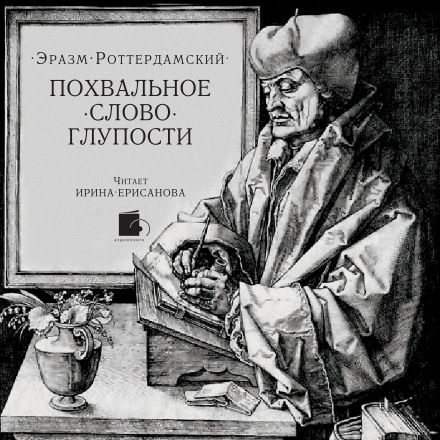
The Praise of Folly
5 hrs. 21 min.
Language
Russian
Author
Erasmus of Rotterdam
Author
Erasmus of Rotterdam
Narrator
Irina Yerisanova
Narrator
Irina Yerisanova
Description
A playful treatise, “In Praise of Folly,” is one of the brightest and most famous satires by the Dutch humanist Erasmus of Rotterdam, a major thinker of the Northern Renaissance, and a writer, philologist, and theologian. “The Praise of Folly,” which became a true masterpiece of Renaissance thought, was created in 1509 and, along with Thomas More’s “Utopia,” anticipated the era of the Reformation. The book was first published in print in Paris in 1511 and was then reissued numerous times. The treatise was translated into Russian in 1840, and since then it has remained one of Erasmus’s best-known and most significant works.
The work is written in a rare format for philosophy—an ironic panegyric. At the center of the narrative is Folly itself, appearing as a living character. Lady Folly, or Moria, as the author calls her, wanders through the world and tells of her origins, her own power, and her “merits,” persuading the reader that people, their fates, and earthly goods are all subject to her. Along the way, she allows herself lyrical digressions and says what, according to her, simply “came into her mind.”
Folly is usually regarded as the cause of wars and misfortunes, deception and lying, superstition and vanity. But the world does not divide into unconditional good and unconditional evil, just as there is no absolute truth or absolute lies. There is a rule of measure—“nothing in excess!” Listen closely—and from the words of the great thinker it will become clear: folly is relative and far from always bringing nothing but troubles.
The work is written in a rare format for philosophy—an ironic panegyric. At the center of the narrative is Folly itself, appearing as a living character. Lady Folly, or Moria, as the author calls her, wanders through the world and tells of her origins, her own power, and her “merits,” persuading the reader that people, their fates, and earthly goods are all subject to her. Along the way, she allows herself lyrical digressions and says what, according to her, simply “came into her mind.”
Folly is usually regarded as the cause of wars and misfortunes, deception and lying, superstition and vanity. But the world does not divide into unconditional good and unconditional evil, just as there is no absolute truth or absolute lies. There is a rule of measure—“nothing in excess!” Listen closely—and from the words of the great thinker it will become clear: folly is relative and far from always bringing nothing but troubles.
100%
32:45
Похвальное слово Глупости 01
36:59
Похвальное слово Глупости 02
34:41
Похвальное слово Глупости 03
41:50
Похвальное слово Глупости 04
43:17
Похвальное слово Глупости 05
1:15:13
Похвальное слово Глупости 06
57:03
Похвальное слово Глупости 07
