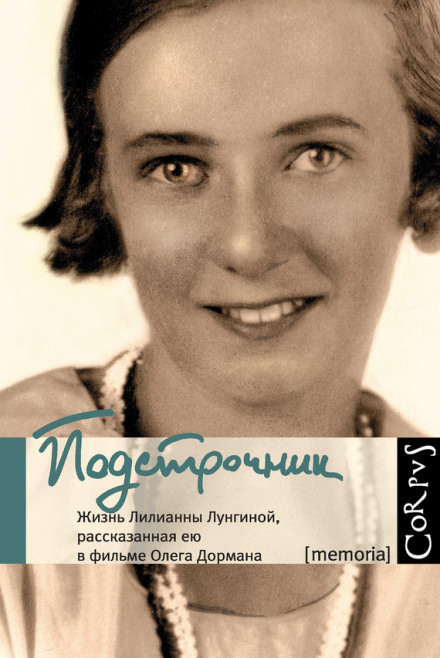
Subtitles: The Life of Lilianna Lungina as Told in Oleg Dorman's Film
12 hrs. 29 min.
Language
Russian
Author
Oleg Dorman
Author
Oleg Dorman
Narrator
Leontina Brotskaya
Narrator
Leontina Brotskaya
Description
Lilianne Lungina is a renowned master of literary translation. Thanks to her, Russian readers learned “Little Man” and Carlson and “Pippi Longstocking” by Astrid Lindgren, the novels of Hamsun, Strindberg, Bell, Simenon, Viana, and Azhar. As a child, she lived in France, Palestine, and Germany; in the early 1930s she returned to her homeland, the USSR.
The story of this extraordinary woman’s life deeply reflects the twentieth century. It is the story of a dramatic era and at the same time an enthralling oral novel, in which there is everything: a family drama—and the destinies of Russian emigrants; love—and a clash with German fascism; her father’s death—and the tragedies of the thirty-seventh year; war and evacuation; “the Thaw,” the collapse of the Soviet empire, and the birth of a new Russia. Viktor Nekrasov, David Samoylov, Tvardovsky, Solzhenitsyn, Yevtushenko, Khrushchev, Sinyavsky, Brodsky, Astrid Lindgren—these are the characters in her narration, distant and close companions of her life, which she agreed to tell on camera in Oleg Dorman’s documentary film.
“Subtext: The Life of Lilianne Lungina, Told by Her in Oleg Dorman’s Film” doesn’t need a subtext: the life of Lilianne Lungina, told by her in Oleg Dorman’s film, along with the foreword, interpretations, and notes. But it is also an “oral book,” a transcript of her story recorded on a television camera for a film of the same name. Perhaps that circumstance is worth highlighting especially, since the reader of the book has the chance to see and hear the primary source on the internet.
I think the monologues of Lilianne Lungina are the most astonishing synchrony (this is what they call speech synchronized with the “image”) in the history of Russian television. The parallels that immediately come to mind: Irakli Andronikov and Yuri Lotman. But one of them was filmed with his stage numbers, while the other was filmed with lectures. Their spoken language was essentially written—because even when it became oral, it had been refined by earlier rehearsals and readings. Lilianne Lungina speaks for the first time. She simply chooses a topic: now I’ll tell about myself in Berlin; now about school; and now how I met my future husband.
But these unprepared texts, first of all, are spoken with that “technical” quality—without filler words, without “uh-uh,” without repetitions, long pauses, stalling, and summary phrases like “what exactly do I want to say with this?”—qualities that are, on their own, absolutely exceptional these days.
Second, these thoughts are born aloud right now, at the moment they are spoken, and they set the rhythm of speech that, fascinating, keeps you, never letting you go. When, explaining how to help dissidents, Lungina pauses slightly and then says, “Here’s the exact word I found: it’s exactly humiliation—not daring to reach out your hand,” she brings to our eyes a verbal formula as a life lesson. The richness and precision of her Russian, of course, were “filled in” by her second, third, and fourth native languages—German, French, and Swedish. After all, she didn’t just translate “Carlson” for Lungina—she created it in Russian, inventing all those “a handsome, moderately plump man in the full bloom of strength” and the rest. Decades of searching for equivalents and synonyms refined the verbal equipment. And even fearless accuracy of her emotional memory did not add to it—they only multiply it.
The story of this extraordinary woman’s life deeply reflects the twentieth century. It is the story of a dramatic era and at the same time an enthralling oral novel, in which there is everything: a family drama—and the destinies of Russian emigrants; love—and a clash with German fascism; her father’s death—and the tragedies of the thirty-seventh year; war and evacuation; “the Thaw,” the collapse of the Soviet empire, and the birth of a new Russia. Viktor Nekrasov, David Samoylov, Tvardovsky, Solzhenitsyn, Yevtushenko, Khrushchev, Sinyavsky, Brodsky, Astrid Lindgren—these are the characters in her narration, distant and close companions of her life, which she agreed to tell on camera in Oleg Dorman’s documentary film.
“Subtext: The Life of Lilianne Lungina, Told by Her in Oleg Dorman’s Film” doesn’t need a subtext: the life of Lilianne Lungina, told by her in Oleg Dorman’s film, along with the foreword, interpretations, and notes. But it is also an “oral book,” a transcript of her story recorded on a television camera for a film of the same name. Perhaps that circumstance is worth highlighting especially, since the reader of the book has the chance to see and hear the primary source on the internet.
I think the monologues of Lilianne Lungina are the most astonishing synchrony (this is what they call speech synchronized with the “image”) in the history of Russian television. The parallels that immediately come to mind: Irakli Andronikov and Yuri Lotman. But one of them was filmed with his stage numbers, while the other was filmed with lectures. Their spoken language was essentially written—because even when it became oral, it had been refined by earlier rehearsals and readings. Lilianne Lungina speaks for the first time. She simply chooses a topic: now I’ll tell about myself in Berlin; now about school; and now how I met my future husband.
But these unprepared texts, first of all, are spoken with that “technical” quality—without filler words, without “uh-uh,” without repetitions, long pauses, stalling, and summary phrases like “what exactly do I want to say with this?”—qualities that are, on their own, absolutely exceptional these days.
Second, these thoughts are born aloud right now, at the moment they are spoken, and they set the rhythm of speech that, fascinating, keeps you, never letting you go. When, explaining how to help dissidents, Lungina pauses slightly and then says, “Here’s the exact word I found: it’s exactly humiliation—not daring to reach out your hand,” she brings to our eyes a verbal formula as a life lesson. The richness and precision of her Russian, of course, were “filled in” by her second, third, and fourth native languages—German, French, and Swedish. After all, she didn’t just translate “Carlson” for Lungina—she created it in Russian, inventing all those “a handsome, moderately plump man in the full bloom of strength” and the rest. Decades of searching for equivalents and synonyms refined the verbal equipment. And even fearless accuracy of her emotional memory did not add to it—they only multiply it.
100%
08:26
00-01-leonid-parfenov-uvidet-raz-i-navsegda
07:49
00-02-oleg-dorman-predislovie
07:57
00-03-lili-lungina
07:41
01-podstrochnik
07:20
02-podstrochnik
11:28
03-podstrochnik
10:01
04-podstrochnik
07:09
05-podstrochnik
07:21
06-podstrochnik
20:15
07-podstrochnik
09:23
08-podstrochnik
10:48
09-podstrochnik
14:43
10-podstrochnik
08:59
11-podstrochnik
10:41
12-podstrochnik
08:56
13-podstrochnik
07:34
14-podstrochnik
18:06
15-podstrochnik
07:47
16-podstrochnik
12:02
17-podstrochnik
18:48
18-podstrochnik
08:53
19-podstrochnik
17:14
20-podstrochnik
11:26
21-podstrochnik
08:15
22-podstrochnik
06:28
23-podstrochnik
05:45
24-podstrochnik
13:30
25-podstrochnik
04:27
26-podstrochnik
08:57
27-podstrochnik
04:44
28-podstrochnik
07:09
29-podstrochnik
05:17
30-podstrochnik
05:25
31-podstrochnik
13:03
32-podstrochnik
09:34
33-podstrochnik
14:43
34-podstrochnik
08:50
35-podstrochnik
13:07
36-podstrochnik
06:11
37-podstrochnik
03:11
38-podstrochnik
15:47
39-podstrochnik
05:05
40-podstrochnik
06:39
41-podstrochnik
07:46
42-podstrochnik
06:22
43-podstrochnik
08:40
44-podstrochnik
08:53
45-podstrochnik
09:30
46-podstrochnik
08:46
47-podstrochnik
05:16
48-podstrochnik
13:35
49-podstrochnik
02:31
50-podstrochnik
24:29
51-podstrochnik
06:28
52-podstrochnik
06:51
53-podstrochnik
08:46
54-podstrochnik
17:36
55-podstrochnik
12:01
56-podstrochnik
15:10
57-podstrochnik
06:39
58-podstrochnik
09:35
59-podstrochnik
01:54
60-podstrochnik
23:42
61-podstrochnik
09:50
62-podstrochnik
05:54
63-podstrochnik
05:53
64-podstrochnik
20:47
65-podstrochnik
23:50
66-podstrochnik
51:30
67-podstrochnik
