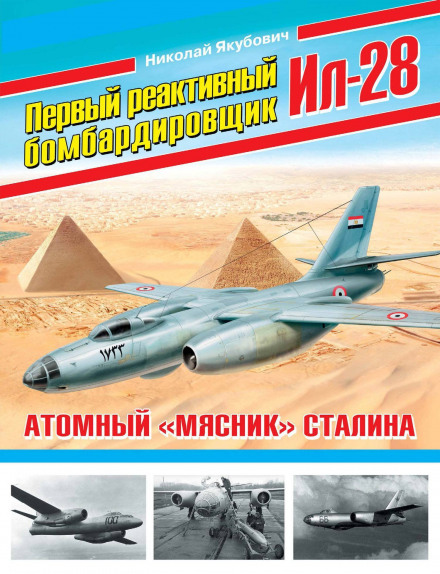
The First Jet Bomber Il-28: Stalin's Atomic Butcher
3 hrs. 50 min.
Language
Russian
Author
Nikolay Yakubovich
Author
Nikolay Yakubovich
Narrator
Vladislav Reshetnikov
Narrator
Vladislav Reshetnikov
Description
This legendary aircraft became the first Soviet jet front-line bomber and then the carrier of the first Soviet serial atomic bomb—participating in nuclear tests near Semipalatinsk and in the only troop exercises using atomic weapons at the Totsk range. After the first public appearance of the Il-28 at the May 1950 parade, NATO command assigned the plane the code name Butcher (“Butcher,” “Executioner”), but later renamed it Beagle (“Hound”). Excellent flight performance, reliability, low cost (the twin-engine Il-28 was cheaper than the single-engine MiG-15), modern equipment (“the Il” had a radar sight that Britain’s closest competitor, the Canberra, did not, and American manufacturers didn’t manage to put a jet front-line bomber into production before the mid-1950s) — the creators of this Soviet aviation masterpiece received a Stalin Prize for their efforts. In total, more than 6,000 Il-28s were built (not only bombers, but also torpedo bombers, reconnaissance aircraft, electronic jammer aircraft, atmospheric sounding aircraft, and so on). They were supplied to 20 countries—from Poland and the GDR to Cuba, Indonesia, North Korea, Morocco, Vietnam, Nigeria, Somalia, and even Finland. Czechoslovakia and China also established their own production of these planes.
The Il-28 took its combat debut in 1956 in Hungary, where Hungarian pilots who had switched sides tried to bomb our crossings over the Tisza. Meanwhile, the Soviet reconnaissance Il-28R performing aerial photography of military facilities was shot down by the Hungarians over Chepel Island (the crew that perished was posthumously awarded the title of Heroes of the Soviet Union). That same year the Egyptians used the Il-28 near the Suez Canal—though without great success (weak preparation of Arab pilots played a role), while the Israeli Air Force also proved unable to strike such targets. During the next Arab–Israeli war of 1967, most of the Egyptian and Syrian “Il” aircraft were destroyed on airfields. Il-28s also took part in the civil war in Yemen and in the fighting of Iraqi forces against Kurdish rebels. Their “swan song” was Afghanistan, where not Soviet but Afghan crews fought on the “Ils” (in the USSR the aircraft had long been removed from production, but exactly these older machines proved “the most suitable for operations in mountainous terrain”).
The Il-28 took its combat debut in 1956 in Hungary, where Hungarian pilots who had switched sides tried to bomb our crossings over the Tisza. Meanwhile, the Soviet reconnaissance Il-28R performing aerial photography of military facilities was shot down by the Hungarians over Chepel Island (the crew that perished was posthumously awarded the title of Heroes of the Soviet Union). That same year the Egyptians used the Il-28 near the Suez Canal—though without great success (weak preparation of Arab pilots played a role), while the Israeli Air Force also proved unable to strike such targets. During the next Arab–Israeli war of 1967, most of the Egyptian and Syrian “Il” aircraft were destroyed on airfields. Il-28s also took part in the civil war in Yemen and in the fighting of Iraqi forces against Kurdish rebels. Their “swan song” was Afghanistan, where not Soviet but Afghan crews fought on the “Ils” (in the USSR the aircraft had long been removed from production, but exactly these older machines proved “the most suitable for operations in mountainous terrain”).
