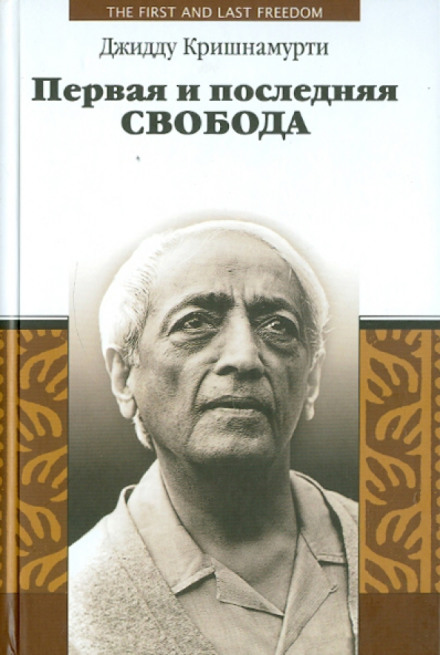
The First and Last Freedom
8 hrs. 13 min.
Language
Russian
Author
Jiddu Krishnamurti
Author
Jiddu Krishnamurti
Narrator
Nikosho
Narrator
Nikosho
Description
“The First and Last Freedom” has for many years remained Jiddu Krishnamurti’s most popular and most frequently reissued book. In it, the author addresses the key questions of human existence. Here, serious philosophical themes are raised—issues close to everyone. The book prompts readers to reflect on the purpose of life, the nature of freedom, and what true happiness is.
From Aldous Huxley’s Preface:
“In this collection of selected talks, readers will find a clear, modern treatment of the most fundamental human problems, and will feel impelled toward their solution by the only possible path—through the human being himself. One cannot rely on the collective solution to difficulties that many so casually and blindly place their hopes on; it is never enough. ‘To understand the suffering and disorder that exist within us and therefore show themselves in the world, we must first come to inner clarity; and clarity is achieved through right thinking. It cannot be organized—one cannot trade it or exchange it. Organized collective thought is like a parrot repeating someone else’s words. Clarity is born not from verbal assertions, but from intense self-observation and right thinking. Right thinking is not a result, nor a simple development of the intellect; it cannot be fitted to any pattern whatsoever, however worthy and noble. It comes together with self-knowledge. Without knowing yourself, there is no basis for thought; without self-knowledge, everything you think is false.’”
From chapter to chapter, Krishnamurti consistently unfolds this central idea. “Hope—directed toward the human being: not toward society, not toward systems, and not toward organized religions, but toward you and me.”
Alternative reading: Krishnamurti Jiddu – The First and Last Freedom [Rumata (LI), 2014, 96 kbps, MP3]
From Aldous Huxley’s Preface:
“In this collection of selected talks, readers will find a clear, modern treatment of the most fundamental human problems, and will feel impelled toward their solution by the only possible path—through the human being himself. One cannot rely on the collective solution to difficulties that many so casually and blindly place their hopes on; it is never enough. ‘To understand the suffering and disorder that exist within us and therefore show themselves in the world, we must first come to inner clarity; and clarity is achieved through right thinking. It cannot be organized—one cannot trade it or exchange it. Organized collective thought is like a parrot repeating someone else’s words. Clarity is born not from verbal assertions, but from intense self-observation and right thinking. Right thinking is not a result, nor a simple development of the intellect; it cannot be fitted to any pattern whatsoever, however worthy and noble. It comes together with self-knowledge. Without knowing yourself, there is no basis for thought; without self-knowledge, everything you think is false.’”
From chapter to chapter, Krishnamurti consistently unfolds this central idea. “Hope—directed toward the human being: not toward society, not toward systems, and not toward organized religions, but toward you and me.”
Alternative reading: Krishnamurti Jiddu – The First and Last Freedom [Rumata (LI), 2014, 96 kbps, MP3]
100%
24:27
01 Часть 1 Глава первая – Вступительная
13:57
02 Глава вторая – Что мы ищем
20:04
03 Глава третья – Личность и общество
21:15
04 Глава четвёртая – Самопознание
17:53
05 Глава пятая – Действие и идея
22:39
06 Глава шестая – Вера
13:41
07 Глава седьмая – Усилие
13:16
08 Глава восьмая – Противоречие
17:57
09 Глава девятая – Что такое наше «сaмо»
12:31
10 Глава десятая – Страх
15:00
11 Глава одиннадцатая – Простота
13:11
12 Глава двенадцатая – Осознавание
13:22
13 Глава тринадцатая – Желание
09:32
14 Глава четырнадцатая – Взаимоотношения и изоляция
07:03
15 Глава пятнадцатая – Мыслитель и мысль
11:52
16 Глава шестнадцатая – Может ли мышление разрешить наши проблемы
13:32
17 Глава семнадцатая – Функция ума
14:32
18 Глава восемнадцатая – Самообман
13:29
19 Глава девятнадцатая – Эго(сaмо)центрическая активность
12:45
20 Глава двадцатая – Время и изменение
18:36
21 Глава двадцать первая – Творческая сила и осознавание
2:52:53
22 Часть 2 Вопросы и ответы
