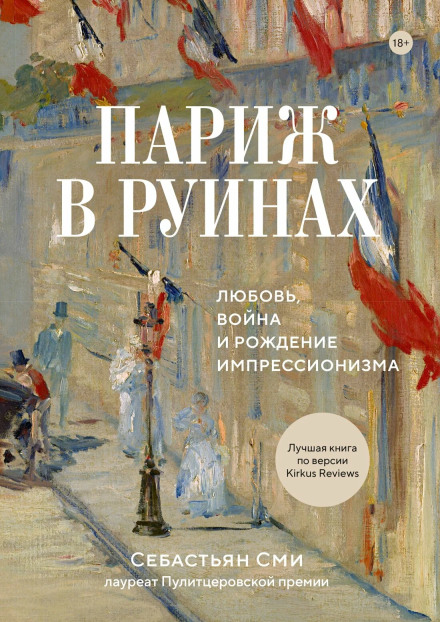
Paris in Ruins: Love, War, and the Birth of Impressionism
16 hrs. 29 min.
Language
Russian
Author
Sebastian Smy
Author
Sebastian Smy
Narrator
Maxim Kireyev
Narrator
Maxim Kireyev
Description
Winter of 1870. Paris is squeezed in a ring of enemy troops, and very soon the city will be engulfed by the fire of civil war. On the streets, typhus and hunger rage, and the only thread connecting the capital with the outside world is hot air balloons and pigeon mail…
Smi recreates the era through the eyes of artists who refused to surrender—neither in everyday life nor in art. In besieged Paris, Manet, Morisot, and Degas continue to work; Renoir and Bazille go to the front; Monet and Pissarro manage to flee. But when they return, they feel especially acutely how precarious human existence is—and turn that feeling into painting. The wound of the “Year of Terror” makes them turn away from heroic rhetoric and look for something else: light, air, the moment, and the fragile beauty of ordinary life.
At the center of the book is a story of love and friendship between Édouard Manet and Berthe Morisot, the first woman Impressionist. Smi restores Morisot her rightful place at the origins of the movement, revealing her complex dialogue with Manet— their mutual attraction and influence on one another.
“Paris in Ruins” is a chronicle of Impressionism and a piercing account of how siege and unrest changed art—and how talent is born out of catastrophe. The reverse side of great painting. Barricades and blood. A text about the death of the old world—and about how out of its ashes a new beauty arises: free, daring, and unending.
Smi recreates the era through the eyes of artists who refused to surrender—neither in everyday life nor in art. In besieged Paris, Manet, Morisot, and Degas continue to work; Renoir and Bazille go to the front; Monet and Pissarro manage to flee. But when they return, they feel especially acutely how precarious human existence is—and turn that feeling into painting. The wound of the “Year of Terror” makes them turn away from heroic rhetoric and look for something else: light, air, the moment, and the fragile beauty of ordinary life.
At the center of the book is a story of love and friendship between Édouard Manet and Berthe Morisot, the first woman Impressionist. Smi restores Morisot her rightful place at the origins of the movement, revealing her complex dialogue with Manet— their mutual attraction and influence on one another.
“Paris in Ruins” is a chronicle of Impressionism and a piercing account of how siege and unrest changed art—and how talent is born out of catastrophe. The reverse side of great painting. Barricades and blood. A text about the death of the old world—and about how out of its ashes a new beauty arises: free, daring, and unending.
100%
41:08
Париж в руинах: любовь, война и рождение импрессионизма 01
1:16:38
Париж в руинах: любовь, война и рождение импрессионизма 02
58:57
Париж в руинах: любовь, война и рождение импрессионизма 03
1:08:00
Париж в руинах: любовь, война и рождение импрессионизма 04
45:02
Париж в руинах: любовь, война и рождение импрессионизма 05
22:32
Париж в руинах: любовь, война и рождение импрессионизма 06
29:09
Париж в руинах: любовь, война и рождение импрессионизма 07
43:56
Париж в руинах: любовь, война и рождение импрессионизма 08
46:48
Париж в руинах: любовь, война и рождение импрессионизма 09
49:33
Париж в руинах: любовь, война и рождение импрессионизма 10
59:43
Париж в руинах: любовь, война и рождение импрессионизма 11
51:02
Париж в руинах: любовь, война и рождение импрессионизма 12
37:52
Париж в руинах: любовь, война и рождение импрессионизма 13
50:22
Париж в руинах: любовь, война и рождение импрессионизма 14
1:00:23
Париж в руинах: любовь, война и рождение импрессионизма 15
27:58
Париж в руинах: любовь, война и рождение импрессионизма 16
50:13
Париж в руинах: любовь, война и рождение импрессионизма 17
54:56
Париж в руинах: любовь, война и рождение импрессионизма 18
45:18
Париж в руинах: любовь, война и рождение импрессионизма 19
36:16
Париж в руинах: любовь, война и рождение импрессионизма 20
33:14
Париж в руинах: любовь, война и рождение импрессионизма 21
