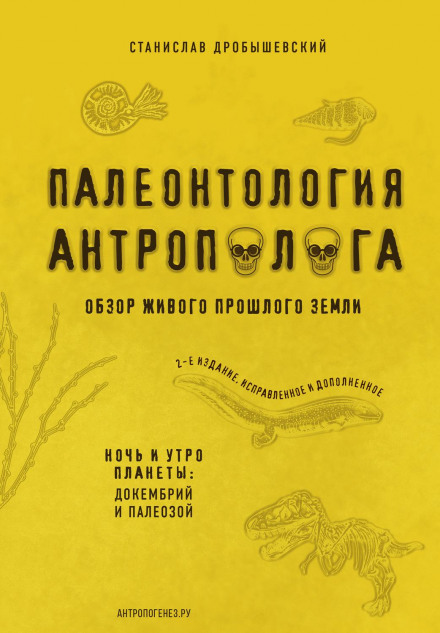
Paleontology of an Anthropologist. Book 1: Precambrian and Paleozoic
12 hrs. 55 min.
Language
Russian
Author
Stanislav Drobyshevsky
Author
Stanislav Drobyshevsky
Narrator
Viktor Babkov
Narrator
Viktor Babkov
Description
A primeval ocean and a poisonous atmosphere. Coming onto land—and terrifying catastrophes. A horror-movie plot, you might think. No— the Precambrian and Paleozoic, we’ll reply.
How did life begin? What happened to the atmosphere? And how did all this affect the development of our Earth?
Billions of years, the Earth revolves around the Sun. For roughly four billion years, life has been teeming on it. We are merely the final stage of a long and complex story—made of myriad strange creatures that invented strange ways to pass their legacy on further. The process is long and uninterrupted. But many times the planet has been shaken by catastrophes.
We know very little about the first of them—the Precambrian. From the darkness of cosmic night, a planet emerged; in the twilight of the primeval ocean, strange chemical reactions took place. In the obscurity of the centuries, the most important secrets of existence are lost— the origin of life itself, the appearance of DNA, multicellularity, and sex. This is the night and the dawn of the planet.
The second catastrophe—the Paleozoic—is illuminated much more fully. The rising dawn of a life fully formed and understandable to us is presented in all its bright colors. Across six periods, all the pillars of our reality appeared, all the major groups of organisms, all the key ecosystems.
Interesting facts, original illustrations, and reconstructions of the planet in different periods of its existence, along with a video introduction to the author on the back of the cover, will help you immerse yourself in the fantastic world of paleontology.
2nd edition, revised and expanded.
How did life begin? What happened to the atmosphere? And how did all this affect the development of our Earth?
Billions of years, the Earth revolves around the Sun. For roughly four billion years, life has been teeming on it. We are merely the final stage of a long and complex story—made of myriad strange creatures that invented strange ways to pass their legacy on further. The process is long and uninterrupted. But many times the planet has been shaken by catastrophes.
We know very little about the first of them—the Precambrian. From the darkness of cosmic night, a planet emerged; in the twilight of the primeval ocean, strange chemical reactions took place. In the obscurity of the centuries, the most important secrets of existence are lost— the origin of life itself, the appearance of DNA, multicellularity, and sex. This is the night and the dawn of the planet.
The second catastrophe—the Paleozoic—is illuminated much more fully. The rising dawn of a life fully formed and understandable to us is presented in all its bright colors. Across six periods, all the pillars of our reality appeared, all the major groups of organisms, all the key ecosystems.
Interesting facts, original illustrations, and reconstructions of the planet in different periods of its existence, along with a video introduction to the author on the back of the cover, will help you immerse yourself in the fantastic world of paleontology.
2nd edition, revised and expanded.
100%
10:28
00_01
59:26
00_02
20:40
01_01
16:18
01_02
49:48
01_03
06:22
01_04
30:37
01_05
1:25:15
02_01
55:06
02_02
19:17
02_03
25:16
02_04
13:56
02_05
44:29
02_06
1:19:10
02_07
39:05
02_08
1:18:49
02_09
25:17
02_10
54:44
02_11
1:01:07
02_12
