Hunting the Setaur
3 hrs. 7 min.
Language
Russian
Author
Stanislaw Lem
Author
Stanislaw Lem
Narrator
Vyacheslav Gerasimov
Narrator
Vyacheslav Gerasimov
Description
(From the collection: Stories about the pilot Pirx)
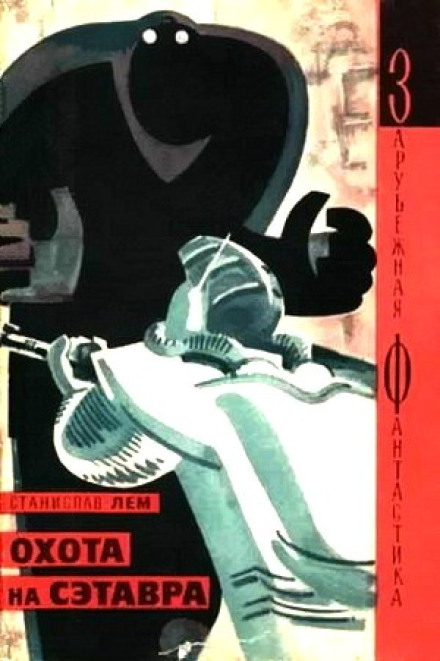
For the navigator pilot Pirx, there is free time on the Moon between flights. And then a call for volunteers is announced, those who want to take part in capturing and neutralizing the robot Setavr—a well-experienced, but little-studied model, two hundred and twenty centimeters tall.
After an accident in a storage facility, the robot begins to behave irrationally and attacks people. The model requires no lubrication, has a massive body and is covered with thick armor capable of withstanding bullets, the impact of a laser beam from about a kilometer away, and it is armed with a laser of an impulse power of about 45,000 kilowatts. It can move at a speed of fifty kilometers per hour, on any terrain. It turns out there are four people capable of piloting jet packs for flights—including Pirx. And soon, the hunt for the robot begins...
The name of Stanislav Lem is well known to Soviet readers. In our country, many of his books have been translated and published—novellas like “The Astronauts,” “The Cloud Magellan,” “Solaris,” “Invincible,” “Return from the Stars,” story cycles like “The Star Diaries of Ijon Tichy” and “Memoirs of Ijon Tichy,” and the collection “Invasion from Aldebaran”; translations of his works often appear in our journals and newspapers.
Lem’s work, deeply original and marked by a unique individuality that makes the author stand out even against the rich and diverse backdrop of contemporary world science fiction, is astonishingly broad in thematic and genre range. At first it’s probably hard to believe that the same writer can create philosophical tragedies like “Solaris” or “Return from the Stars,” and almost farcical stories in terms of technique—sometimes wildly funny, sometimes caustically mocking—about “the cosmic Münchhausen,” about the fearless space-tramp Ijon Tichy, always remaining at the very highest level accessible to modern science fiction (and, in fact, to modern literature in general). But for a thoughtful reader, this breadth of range seems natural and necessary: it is caused by the complexity and depth of the tasks Stanislav Lem sets himself.
In the collection “The Hunt for Setavr,” offered to readers by the publishing house “Mir,” completely different lines of Lem’s creativity are also presented—diametrically opposite, at first glance.
Most of the collection is taken up by stories about the space pilot Pirx, which form a cycle. The first stories of this cycle were written seven years ago (they were included in the collection “Invasion from Aldebaran”); the last—“The Hunt for Setavr”—was finished in December 1964. Lem continues to work on the image of this hero.
The cycle of stories about Pirx is almost unique in world science fiction. Characters drawn with realistic versatility and depth are rare in fiction; it tends to focus primarily on issues facing humankind as a whole, which is hard to reconcile with detailed psychological development of the image of a single person. Even with Herbert Wells, who used realism techniques to the maximum extent, there aren’t that many heroes one could say have individuality (the most striking among them is Griffin, the hero of “The Invisible Man”).
For the navigator pilot Pirx, there is free time on the Moon between flights. And then a call for volunteers is announced, those who want to take part in capturing and neutralizing the robot Setavr—a well-experienced, but little-studied model, two hundred and twenty centimeters tall.
After an accident in a storage facility, the robot begins to behave irrationally and attacks people. The model requires no lubrication, has a massive body and is covered with thick armor capable of withstanding bullets, the impact of a laser beam from about a kilometer away, and it is armed with a laser of an impulse power of about 45,000 kilowatts. It can move at a speed of fifty kilometers per hour, on any terrain. It turns out there are four people capable of piloting jet packs for flights—including Pirx. And soon, the hunt for the robot begins...
The name of Stanislav Lem is well known to Soviet readers. In our country, many of his books have been translated and published—novellas like “The Astronauts,” “The Cloud Magellan,” “Solaris,” “Invincible,” “Return from the Stars,” story cycles like “The Star Diaries of Ijon Tichy” and “Memoirs of Ijon Tichy,” and the collection “Invasion from Aldebaran”; translations of his works often appear in our journals and newspapers.
Lem’s work, deeply original and marked by a unique individuality that makes the author stand out even against the rich and diverse backdrop of contemporary world science fiction, is astonishingly broad in thematic and genre range. At first it’s probably hard to believe that the same writer can create philosophical tragedies like “Solaris” or “Return from the Stars,” and almost farcical stories in terms of technique—sometimes wildly funny, sometimes caustically mocking—about “the cosmic Münchhausen,” about the fearless space-tramp Ijon Tichy, always remaining at the very highest level accessible to modern science fiction (and, in fact, to modern literature in general). But for a thoughtful reader, this breadth of range seems natural and necessary: it is caused by the complexity and depth of the tasks Stanislav Lem sets himself.
In the collection “The Hunt for Setavr,” offered to readers by the publishing house “Mir,” completely different lines of Lem’s creativity are also presented—diametrically opposite, at first glance.
Most of the collection is taken up by stories about the space pilot Pirx, which form a cycle. The first stories of this cycle were written seven years ago (they were included in the collection “Invasion from Aldebaran”); the last—“The Hunt for Setavr”—was finished in December 1964. Lem continues to work on the image of this hero.
The cycle of stories about Pirx is almost unique in world science fiction. Characters drawn with realistic versatility and depth are rare in fiction; it tends to focus primarily on issues facing humankind as a whole, which is hard to reconcile with detailed psychological development of the image of a single person. Even with Herbert Wells, who used realism techniques to the maximum extent, there aren’t that many heroes one could say have individuality (the most striking among them is Griffin, the hero of “The Invisible Man”).
100%
10:01
301
10:04
302
10:04
303
10:02
304
10:08
305
10:06
306
10:03
307
10:16
308
10:13
309
10:07
310
10:03
311
10:10
312
10:13
313
10:01
314
10:03
315
10:02
316
10:01
317
10:01
318
05:23
319
