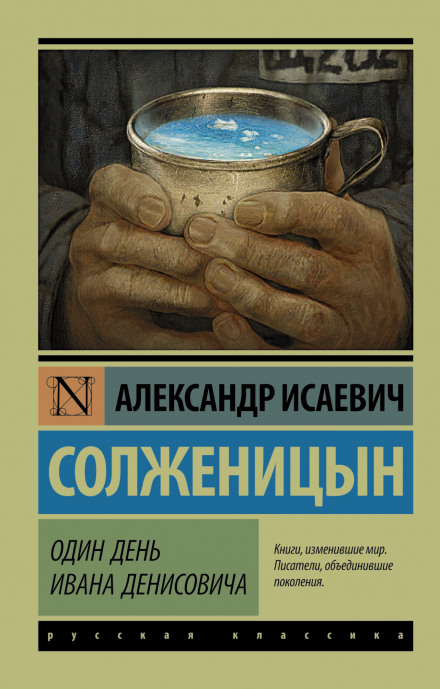
One Day in the Life of Ivan Denisovich
4 hrs. 28 min.
Language
Russian
Author
Alexander Solzhenitsyn
Author
Alexander Solzhenitsyn
Narrator
Alexander Solzhenitsyn
Narrator
Alexander Solzhenitsyn
Description
A peasant and a front-line soldier, Ivan Denisovich Shukhov, was labeled a “state criminal,” a “spy,” and ended up in one of Stalin’s camps—like millions of Soviet people—without guilt, condemned during the era of the “cult of personality” and mass repressions.
He left home on June 23, 1941, the second day after the start of the war with Hitler’s Germany, “... in February forty-two on the North-West [front] their army was surrounded the whole, and no one threw them food from the planes, and there were no planes either. They got to the point of scraping the hooves off dead horses, soaking the leather in water, and eating it,” that is: the command of the Red Army threw its soldiers to die in encirclement. Together with a group of fighters, Shukhov found himself in German captivity, escaped from the Germans, and miraculously reached his own. An indiscreet account of how he had been in captivity led him—by the time he was already in a Soviet concentration camp—because the state security authorities treated all escapees from captivity indiscriminately as spies and saboteurs.
The second part of Shukhov’s memories and reflections during long camp labor and short rest in the barracks concerns his life in the village. From the fact that relatives don’t send him food (in his letter to his wife he refused parcels himself), we understand that in the village people starve no less than in the camp. His wife writes that the collective farmers live by coloring counterfeit carpets and selling them to city dwellers.
If you leave aside retrospective digressions and occasional information about life beyond the barbed wire, the entire story takes place exactly over the course of one day. In this short span, a panorama of camp life unfolds before us—like a kind of “encyclopedia” of life in the camp.
First of all, a detailed gallery of social types and, at the same time, vivid human characters: Caesar—an educated city intellectual, a former film director who, even in the camp, manages a comparatively “genteel” life like Shukhov’s superiors: he receives food parcels, benefits from certain privileges during work. Kawtorang—a repressed naval officer. An old convict, a penal labor veteran who had already been in царist prisons and on penal settlements (an old revolutionary guard that couldn’t find common ground with Bolshevik policy in the 1930s). The Estonians and Latvians—so-called “bourgeois nationalists.” Baptist Alyosha—representing thoughts and a way of life of a very diverse religious Russia. Gopchik—a sixteen-year-old boy whose fate shows that repressions did not distinguish between children and adults. And Shukhov himself is also a typical representative of Russian peasantry, with his special business acumen and organic way of thinking. Against the backdrop of these people harmed by repressions, a different figure stands out—the camp regime officer Volkov, who regulates the prisoners’ lives and, in a sense, symbolizes the ruthless Communist regime.
Secondly, a more detailed depiction of camp routines and labor. Life in the camp remains life—with its visible and invisible passions and its subtlest experiences. Mostly they are connected with the problem of getting food. They feed poorly and in small amounts with dreadful cabbage soup with frozen cabbage and small fish. A kind of art of surviving in the camp is to obtain yourself an extra ration of bread and an extra bowl of soup, and if you are lucky—some tobacco. For that, you have to resort to the greatest tricks, ingratiating yourself with “authorities” like Caesar and others. At the same time, it is important to preserve one’s human dignity, not to become a “fallen” beggar—like, for example, Fetyukov (though there aren’t many such people in the camp). This matters not even for noble reasons, but because it is necessary: the “fallen” person loses the will to live and inevitably dies. Thus, the question of keeping in yourself an image of humanity becomes a question of survival.
A second vital question is one’s attitude toward compulsory labor. Prisoners, especially in winter, work willingly—almost competing with one another and brigade against brigade—in order not to freeze and, in a way, “to shorten” time from bunk to bunk, from feeding to feeding. On this stimulus, the terrifying system of collective labor is built. But still, it does not completely extinguish in people the natural joy of physical work: the scene of building a house by the brigade where Shukhov works is one of the most inspired in the story.
The ability to work “properly” (without overexerting yourself, but also without shirking)—and the ability to obtain extra rations—is also a high art. As well as the ability to hide from guards’ eyes the piece of saw that happens to come along, from which camp craftsmen make miniature penknives for trading—for food, tobacco, warm clothing… With regard to the guards who constantly run “shmonas” (searches), Shukhov and the other prisoners are like wild animals: they must be craftier and more agile than armed men who have the right to punish them and even shoot them for deviating from camp rules. To fool the guards and the camp administration is also a high art.
That day, which the hero recounts, in his own view was a lucky one: “they didn’t put him in the punishment cell, they didn’t drive the brigade out to the Socgorodok (winter work in an open field—editor’s note), at lunch he faked being ill to get extra porridge (editor’s note), the foreman closed the percent schedule well (a camp work-evaluation system—editor’s note), Shukhov built the wall cheerfully, didn’t get caught with the hacksaw during a shmon, did some extra work in the evening for Caesar and bought tobacco. And he didn’t get sick—he held on. The day went by, unclouded by anything, almost happy. Such days in his term from bell to bell were 3,653. Because of leap years—three extra days were added...”
Read more...
He left home on June 23, 1941, the second day after the start of the war with Hitler’s Germany, “... in February forty-two on the North-West [front] their army was surrounded the whole, and no one threw them food from the planes, and there were no planes either. They got to the point of scraping the hooves off dead horses, soaking the leather in water, and eating it,” that is: the command of the Red Army threw its soldiers to die in encirclement. Together with a group of fighters, Shukhov found himself in German captivity, escaped from the Germans, and miraculously reached his own. An indiscreet account of how he had been in captivity led him—by the time he was already in a Soviet concentration camp—because the state security authorities treated all escapees from captivity indiscriminately as spies and saboteurs.
The second part of Shukhov’s memories and reflections during long camp labor and short rest in the barracks concerns his life in the village. From the fact that relatives don’t send him food (in his letter to his wife he refused parcels himself), we understand that in the village people starve no less than in the camp. His wife writes that the collective farmers live by coloring counterfeit carpets and selling them to city dwellers.
If you leave aside retrospective digressions and occasional information about life beyond the barbed wire, the entire story takes place exactly over the course of one day. In this short span, a panorama of camp life unfolds before us—like a kind of “encyclopedia” of life in the camp.
First of all, a detailed gallery of social types and, at the same time, vivid human characters: Caesar—an educated city intellectual, a former film director who, even in the camp, manages a comparatively “genteel” life like Shukhov’s superiors: he receives food parcels, benefits from certain privileges during work. Kawtorang—a repressed naval officer. An old convict, a penal labor veteran who had already been in царist prisons and on penal settlements (an old revolutionary guard that couldn’t find common ground with Bolshevik policy in the 1930s). The Estonians and Latvians—so-called “bourgeois nationalists.” Baptist Alyosha—representing thoughts and a way of life of a very diverse religious Russia. Gopchik—a sixteen-year-old boy whose fate shows that repressions did not distinguish between children and adults. And Shukhov himself is also a typical representative of Russian peasantry, with his special business acumen and organic way of thinking. Against the backdrop of these people harmed by repressions, a different figure stands out—the camp regime officer Volkov, who regulates the prisoners’ lives and, in a sense, symbolizes the ruthless Communist regime.
Secondly, a more detailed depiction of camp routines and labor. Life in the camp remains life—with its visible and invisible passions and its subtlest experiences. Mostly they are connected with the problem of getting food. They feed poorly and in small amounts with dreadful cabbage soup with frozen cabbage and small fish. A kind of art of surviving in the camp is to obtain yourself an extra ration of bread and an extra bowl of soup, and if you are lucky—some tobacco. For that, you have to resort to the greatest tricks, ingratiating yourself with “authorities” like Caesar and others. At the same time, it is important to preserve one’s human dignity, not to become a “fallen” beggar—like, for example, Fetyukov (though there aren’t many such people in the camp). This matters not even for noble reasons, but because it is necessary: the “fallen” person loses the will to live and inevitably dies. Thus, the question of keeping in yourself an image of humanity becomes a question of survival.
A second vital question is one’s attitude toward compulsory labor. Prisoners, especially in winter, work willingly—almost competing with one another and brigade against brigade—in order not to freeze and, in a way, “to shorten” time from bunk to bunk, from feeding to feeding. On this stimulus, the terrifying system of collective labor is built. But still, it does not completely extinguish in people the natural joy of physical work: the scene of building a house by the brigade where Shukhov works is one of the most inspired in the story.
The ability to work “properly” (without overexerting yourself, but also without shirking)—and the ability to obtain extra rations—is also a high art. As well as the ability to hide from guards’ eyes the piece of saw that happens to come along, from which camp craftsmen make miniature penknives for trading—for food, tobacco, warm clothing… With regard to the guards who constantly run “shmonas” (searches), Shukhov and the other prisoners are like wild animals: they must be craftier and more agile than armed men who have the right to punish them and even shoot them for deviating from camp rules. To fool the guards and the camp administration is also a high art.
That day, which the hero recounts, in his own view was a lucky one: “they didn’t put him in the punishment cell, they didn’t drive the brigade out to the Socgorodok (winter work in an open field—editor’s note), at lunch he faked being ill to get extra porridge (editor’s note), the foreman closed the percent schedule well (a camp work-evaluation system—editor’s note), Shukhov built the wall cheerfully, didn’t get caught with the hacksaw during a shmon, did some extra work in the evening for Caesar and bought tobacco. And he didn’t get sick—he held on. The day went by, unclouded by anything, almost happy. Such days in his term from bell to bell were 3,653. Because of leap years—three extra days were added...”
100%
06:01
0001
05:06
0002
05:08
0003
04:54
0004
04:58
0005
05:01
0006
05:22
0007
07:03
0008
05:56
0009
04:37
0010
06:37
0011
04:14
0012
05:44
0013
04:28
0014
04:05
0015
05:06
0016
05:16
0017
05:55
0018
05:16
0019
04:50
0020
05:07
0021
04:57
0022
04:53
0023
05:21
0024
05:37
0025
06:07
0026
04:03
0027
04:45
0028
04:04
0029
06:27
0030
05:45
0031
05:26
0032
05:20
0033
05:19
0034
05:18
0035
05:23
0036
04:55
0037
05:01
0038
04:56
0039
04:53
0040
05:17
0041
05:10
0042
04:59
0043
04:50
0044
04:54
0045
05:00
0046
05:41
0047
05:22
0048
05:27
0049
05:07
0050
05:19
0051
02:35
0052
