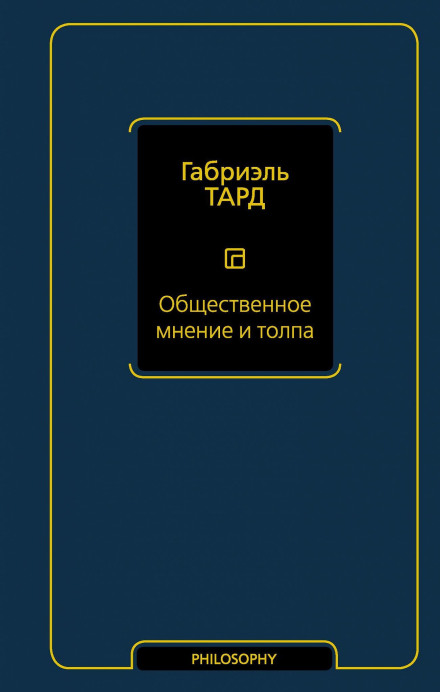
Public Opinion and the Crowd
6 hrs. 36 min.
Language
Russian
Author
Gabriel Tarde
Author
Gabriel Tarde
Narrator
Dmitry Chepusov
Narrator
Dmitry Chepusov
Description
ILLEGAL USE OF NARCOTIC SUBSTANCES, PSYCHOTROPIC DRUGS AND THEIR ANALOGS CAUSES HARM TO HEALTH. THEIR ILLEGAL TRAFFICKING IS PROHIBITED AND ENTAILS LIABILITY PROVIDED BY LEGISLATION
This is a fundamental work that laid the foundations of modern sociology. Tarde draws a subtle line between the primitive “mob” and a media-managed “audience,” showing how public opinion is formed and why, in the era of mass communication, manipulating the consciousness of millions has become easier than ever. Written in the nineteenth century, the book remains an astonishingly accurate diagnosis of the informational reality of the twenty-first.
Gabriel Tarde (1843–1904) was a prominent French criminologist, psychologist, and philosopher; a member of the Academy of Moral and Political Sciences—but above all, one of the scholars at the origins of the creation of scientific sociology. He developed his unique “subjective-psychological” theory back in the 1870s and spent a full 20 years developing and refining it. His contribution to sociology is hard to overestimate: for instance, Tarde is considered the creator of two directions of modern sociology—mass culture theory and the analysis of public opinion.
“Public Opinion and the Crowd” is a book first published by Tarde in 1892, yet it has not lost relevance to this day. It is one of the foundational works of mass communication theory. In it, the scholar discusses the “audience” as the highest form of the crowd—an inert, credulous mass, short-lived and dependent on its leader.
The audience is also dependent—only this time on the mass media, which sequentially shape its opinion. It is united by a community of judgments (implanted from outside, again using the same mass media) and tends toward novelty. Socially, it is more closed-off than the crowd, and more tolerant of other people’s opinions. However, enough to manipulate it with opinion in a sufficiently competent way, and the audience will turn again into a destructive crowd…
This is a fundamental work that laid the foundations of modern sociology. Tarde draws a subtle line between the primitive “mob” and a media-managed “audience,” showing how public opinion is formed and why, in the era of mass communication, manipulating the consciousness of millions has become easier than ever. Written in the nineteenth century, the book remains an astonishingly accurate diagnosis of the informational reality of the twenty-first.
Gabriel Tarde (1843–1904) was a prominent French criminologist, psychologist, and philosopher; a member of the Academy of Moral and Political Sciences—but above all, one of the scholars at the origins of the creation of scientific sociology. He developed his unique “subjective-psychological” theory back in the 1870s and spent a full 20 years developing and refining it. His contribution to sociology is hard to overestimate: for instance, Tarde is considered the creator of two directions of modern sociology—mass culture theory and the analysis of public opinion.
“Public Opinion and the Crowd” is a book first published by Tarde in 1892, yet it has not lost relevance to this day. It is one of the foundational works of mass communication theory. In it, the scholar discusses the “audience” as the highest form of the crowd—an inert, credulous mass, short-lived and dependent on its leader.
The audience is also dependent—only this time on the mass media, which sequentially shape its opinion. It is united by a community of judgments (implanted from outside, again using the same mass media) and tends toward novelty. Socially, it is more closed-off than the crowd, and more tolerant of other people’s opinions. However, enough to manipulate it with opinion in a sufficiently competent way, and the audience will turn again into a destructive crowd…
100%
03:56
Общественное мнение и толпа 01
1:52:26
Общественное мнение и толпа 02
36:35
Общественное мнение и толпа 03
2:05:59
Общественное мнение и толпа 04
1:57:55
Общественное мнение и толпа 05
