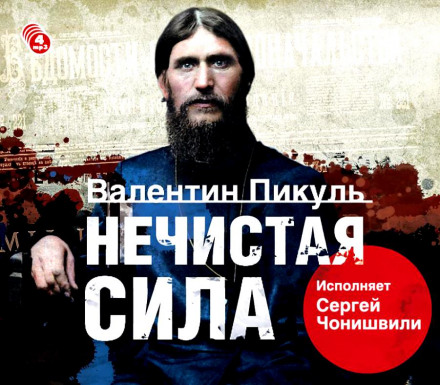
Unclean Force
27 hrs. 50 min.
Language
Russian
Author
Valentin Pikul
Author
Valentin Pikul
Narrator
Sergey Chonishvili
Narrator
Sergey Chonishvili
Description
A story about the life and death of one of Russia’s most ambiguous figures—Grigory Rasputin—grows under Pikul’s pen into a large-scale, captivating narrative about perhaps the most paradoxical period for our country: the brief pause between two revolutions (1905 and February…)
It first appeared in print (in an abridged form) in 1979 under the title “On the Very Last Line” in the journal “Our Contemporary” (NN4-7).
Valentin Pikul considered “The Unclean Power” the main success in his literary biography. But this novel had a very complicated fate. Here is how the author himself recalled it: “I remember that even before I began writing this book, I had already started receiving filthy anonymous letters warning me that for writing about Rasputin, I’d be dealt with. The threats said: you can write about anything you want, but only don’t touch Grigory Rasputin and his best friends.”
In any case, the novel was written and published as a separate book before its stand-alone release—it was published in “Our Contemporary,” but under a different title and with such abbreviations that it was simply impossible to judge it from these fragments. However, even those small excerpts were enough for the then leadership of the country headed by L.I. Brezhnev to see in scenes of corruption at the court of Nicholas II… themselves. And this led to the novel and the author’s name being surrounded by a “vacuum of ominous silence.”
In Pikul’s creative career, work on the novel “The Unclean Power” became a very important stage. But in his personal life it was a catastrophically difficult time, leaving deep traces—both as scars that never truly healed until the end of his life. According to Valentin Savvich, he worked his way toward this novel for more than ten years. How much material had to be “sorted through”! Not counting the small newspaper and magazine notes he read by the hundreds, the “list of literature lying on the author’s desk,” added to the manuscript, included 128 titles.
For “The Unclean Power,” there were two reviews—different in form and content, but similar in their categorical rejection of the book. “The manuscript of V. Pikul’s novel ‘The Unclean Power’ cannot be accepted for publication because… it is an expanded argument for the notorious thesis: the people have the rulers they deserve. And that is offensive to the great people, to the great country”—as the editorial conclusion put it. That’s how the burial of “The Unclean Power” took place.”
It first appeared in print (in an abridged form) in 1979 under the title “On the Very Last Line” in the journal “Our Contemporary” (NN4-7).
Valentin Pikul considered “The Unclean Power” the main success in his literary biography. But this novel had a very complicated fate. Here is how the author himself recalled it: “I remember that even before I began writing this book, I had already started receiving filthy anonymous letters warning me that for writing about Rasputin, I’d be dealt with. The threats said: you can write about anything you want, but only don’t touch Grigory Rasputin and his best friends.”
In any case, the novel was written and published as a separate book before its stand-alone release—it was published in “Our Contemporary,” but under a different title and with such abbreviations that it was simply impossible to judge it from these fragments. However, even those small excerpts were enough for the then leadership of the country headed by L.I. Brezhnev to see in scenes of corruption at the court of Nicholas II… themselves. And this led to the novel and the author’s name being surrounded by a “vacuum of ominous silence.”
In Pikul’s creative career, work on the novel “The Unclean Power” became a very important stage. But in his personal life it was a catastrophically difficult time, leaving deep traces—both as scars that never truly healed until the end of his life. According to Valentin Savvich, he worked his way toward this novel for more than ten years. How much material had to be “sorted through”! Not counting the small newspaper and magazine notes he read by the hundreds, the “list of literature lying on the author’s desk,” added to the manuscript, included 128 titles.
For “The Unclean Power,” there were two reviews—different in form and content, but similar in their categorical rejection of the book. “The manuscript of V. Pikul’s novel ‘The Unclean Power’ cannot be accepted for publication because… it is an expanded argument for the notorious thesis: the people have the rulers they deserve. And that is offensive to the great people, to the great country”—as the editorial conclusion put it. That’s how the burial of “The Unclean Power” took place.”
100%
31:23
01_00_Prolog, kotoryy mog by stat epilogom
12:15
01_01_Gatchinskie zatvorniki
14:32
01_02_Suschiy mladenets Niki
10:06
01_03_Gessenskaya muha
10:20
01_04_Vospitatelnoe puteshestvie
09:40
01_05_Koleso istorii
16:41
01_06_Skandal v Livadii
14:19
01_07_Nechistaya sila
18:07
01_08_Zhitie tsarya tishayshego
14:47
01_09_Pervye prizraki
15:21
01_10_Zverinyy ryk
12:37
01_11_Yavlenie messii
17:53
01_12_Chudo bez chudes
10:40
01_13_Besstyzhiy apostol
24:28
01_14_Parlament na krovi
10:24
02_00_Prelyudiya ko vtoroy chasti
14:27
02_01_Pervyy blin komom
14:16
02_02_Salonnaya zhizn
14:01
02_03_«Nana» uzhe tresnula
03:47
02_04_Samaya korotkaya glava
18:09
02_05_Temnye lyudi
14:30
02_06_Iz gryazi da v knyazi
14:04
02_07_Duma pered dumoy
14:43
02_08_Pochti kak v Anglii
18:48
02_09_Durakam vse v radost
19:09
02_10_Bomba v portfele
20:42
02_11_Lampadnyy Grishenka
15:40
02_12_Premery i primery
15:27
02_13_Druzya-priyateli
11:03
02_14_Final vtoroy chasti
17:01
03_00_Prelyudiya k tretey chasti
12:33
03_01_Skandalnaya zhizn
14:45
03_02_Cela me chatoville
11:35
03_03_Hot topor veshay!
16:39
03_04_Grom i molniya
15:50
03_05_Moy pupsik – moltke
13:59
03_06_Barhatnyy sezon
17:18
03_07_Izgnanie bludnogo besa
17:11
03_08_Rodnye penaty
15:32
03_09_Vunderkind s saharnoy golovkoy
21:10
03_10_Kolovraschenie zhizni
13:46
03_11_I dazhe betonnye truby
15:40
03_12_Tri opasnyh svidaniya
15:27
03_13_Na vysshem i nizshem urovne
09:27
03_14_Final tretey chasti
12:31
04_00_Prelyudiya k chetvertoy chasti
12:51
04_01_Muravinaya kucha
11:41
04_02_Sabler bezo vsyakih «no»
13:52
04_03_Prohindei za rabotoy
11:11
04_04_Provokator nuzhen
11:47
04_05_Na blankah «shtandarta»
12:15
04_06_Tretya dekada avgusta
14:17
04_07_Skazka pro belogo bychka
16:58
04_08_Skazka o tsare Saltane
14:52
04_09_Teper otdyhat v Livadiyu
10:28
04_10_Tak bylo – tak budet!
17:05
04_11_Kuterma s nozhnitsami
15:32
04_12_Natisk prodolzhaetsya
15:23
04_13_Odin Rasputin ili desyat isterik
09:37
04_14_Final chetvertoy chasti
12:39
05_00_Prelyudiya k pyatoy chasti
14:45
05_01_Verbovka agentov
15:33
05_02_Slepaya kishka
11:00
05_03_Medlennoe krovotechenie
14:08
05_04_V kanun torzhestva
16:39
05_05_Romanovskie torzhestva
11:20
05_06_Goremychnye istorii
15:43
05_07_«My gotovy!»
11:16
05_08_Geroi sumerek
24:10
05_09_Iyulskaya lihoradka
11:05
05_10_«Pobolshe dopinga!»
12:59
05_11_Zato Parizh byl spasen
10:18
05_12_Final pyatoy chasti
12:35
06_00_Prelyudiya k shestoy chasti
14:49
06_01_Vse stavki na stavku
19:17
06_02_Shtab-kvartira imperii
13:14
06_03_Ubienie «nevinnyh» mladentsev
12:09
06_04_Poklonenie svyatym moscham
16:11
06_05_Otkrytye semafory
11:53
06_06_«A nam naplevat!»
16:55
06_07_Melochi zhizni
16:30
06_08_Kesaryu – kesarevo
12:13
06_09_Mafiya – v pote litsa
15:53
06_10_Praktika bez teorii
13:37
06_11_Zagotovka drov
15:53
06_12_Final shestoy chasti
13:35
07_00_Prelyudiya k sedmoy chasti
14:24
07_01_Myshinaya voznya
12:20
07_02_Bey dubem i rublem
14:21
07_03_Nasha Masha privezla mir
12:28
07_04_«Navi chary»
11:33
07_05_Moi lyubimye dohlye koshki
12:24
07_06_Ahtung – Shtyurmer!
14:58
07_07_Hvost v kapkane
17:32
07_08_Kogda otdyhayut mozgi
12:58
07_09_Tort ot «Kvisisany»
18:53
07_10_«My ploho konchim…»
17:03
07_11_Voyna ili mir
20:47
07_12_Golosa pevtsov za stsenoy
21:50
07_13_«Pro to popka vedaet…»
11:48
07_14_Final sedmoy chasti
18:07
08_00_Prelyudiya k posledney chasti
13:15
08_01_Bravo, Purishkevich, bravo!
16:40
08_02_Anketa na ubiyts
18:12
08_03_«Ne sprashivay, ne vypytyvay, levkonoya…»
11:00
08_04_Do shestnadtsatogo
16:03
08_05_Posledniy den messii
13:43
08_06_Velikosvetskiy raut
14:04
08_07_«Vizantiyskaya» noch
20:44
08_08_Semeynaya revolyutsiya
15:10
08_09_Trupnoe delo
02:22
08_10_Rasputin zhiv!
15:42
08_11_Zhenschinam posvyaschaetsya
15:23
08_12_Final posledney chasti
