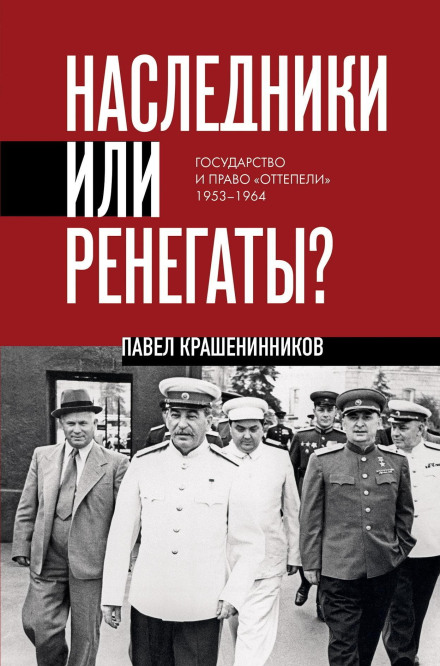
Heirs or Renegades. The State and Law of the Thaw 1953–1964
9 hrs. 3 min.
Language
Russian
Author
Pavel Krasheninnikov
Author
Pavel Krasheninnikov
Narrator
Ilya Dementyev
Narrator
Ilya Dementyev
Description
In the period 1953–1964, the Soviet Union experienced significant changes that left a deep mark on Soviet society. During this time, a contradiction emerged between romantic revolutionaries, full of heroic aspirations, and pragmatic townspeople who sought to improve their well-being immediately. The authorities tried to maintain a balance between these two groups, but ultimately failed. This outcome can be seen as a consequence of mistakes made by Khrushchev’s leadership, or as the inevitable development of historical events. The book also includes essays about outstanding jurists of that time and the codification of complex legislation inherited from the Lenin and Stalin era. Following earlier researchers, this period is described as the “Khrushchev Thaw” and divided into four key stages. The first stage covers Stalin’s death, collective leadership, and the struggle for power (1953–1954). The second stage is related to the concentration of power in Khrushchev’s hands (1954–1956). In the third stage, the cult of Stalin’s personality is exposed, mass repressions are rejected after the 20th Congress of the CPSU, and the body is moved from the mausoleum onto Red Square (February 1956 – October 31, 1961). The fourth stage continues until Khrushchev is removed from office (late 1961 – 1964).
