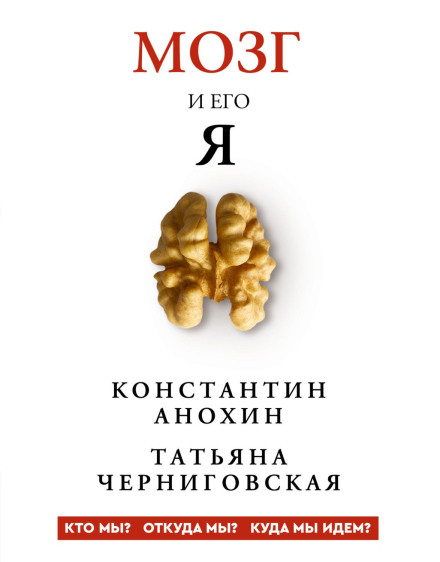
The Brain and Its 'Self'. Who Are We? Where Do We Come From? Where Are We Going?
19 hrs. 12 min.
Language
Russian
Author
Tatyana Chernigovskaya
Author
Tatyana Chernigovskaya
Narrators
Filipp Matveev-Vitovsky, Irina Bulekova, Artyom Kukharev, Denis Dulshchikov, Olga Potorochina
Narrator
Filipp Matveev-Vitovsky
Narrator
Irina Bulekova
Narrator
Artyom Kukharev
Narrator
Denis Dulshchikov
Narrator
Olga Potorochina
Description
Konstantin Anokhin is a neuroscientist and researcher of cognitive processes. He heads the Institute for Advanced Brain Research at Lomonosov Moscow State University. Professor, Academician of the RAS.
Tatyana Chernigovskaya is a neurolinguist, specializing in cognitive research. She leads the Institute of Cognitive Studies at St. Petersburg State University. Professor, Academician of the RAO.
The brain is the most complex of the material systems known to humankind. In recent decades, science has advanced its study of it unprecedentedly far, yet the key riddles of the brain still remain unsolved.
The book “The Brain and Its ‘I’” brings the reader back to the central questions: “Who are we?”, “Where do we come from?”, “Where are we going?” Over the centuries, they have turned into a tight knot of problems about the nature of the human “I,” the soul, the psyche, the mind, and consciousness—about how they relate to one another, to the body and the brain, and about their origins and their role in the structure of the world. It is becoming increasingly clear that simply accumulating new data about the brain will not, by itself, bring us closer to answers. What is needed is a trajectory of movement. The authors propose one: amid a series of intense discussions held in the very heart of Altai, on the banks of the Katun River, they identify twenty fundamental questions of contemporary brain science and, step by step, outline possible contours of solutions.
In form—a combination of historical excursions, dialogues, and the accompanying analysis—the book resonates with the classic work by Karl Popper and John Eccles, “The ‘Self’ and Its Brain.” Half a century later, Konstantin Anokhin and Tatyana Chernigovskaya reinterpret what has changed in this long-standing problem today and try to look beyond the horizon of the known—toward the future of brain research as the center of our “I.”
Tatyana Chernigovskaya is a neurolinguist, specializing in cognitive research. She leads the Institute of Cognitive Studies at St. Petersburg State University. Professor, Academician of the RAO.
The brain is the most complex of the material systems known to humankind. In recent decades, science has advanced its study of it unprecedentedly far, yet the key riddles of the brain still remain unsolved.
The book “The Brain and Its ‘I’” brings the reader back to the central questions: “Who are we?”, “Where do we come from?”, “Where are we going?” Over the centuries, they have turned into a tight knot of problems about the nature of the human “I,” the soul, the psyche, the mind, and consciousness—about how they relate to one another, to the body and the brain, and about their origins and their role in the structure of the world. It is becoming increasingly clear that simply accumulating new data about the brain will not, by itself, bring us closer to answers. What is needed is a trajectory of movement. The authors propose one: amid a series of intense discussions held in the very heart of Altai, on the banks of the Katun River, they identify twenty fundamental questions of contemporary brain science and, step by step, outline possible contours of solutions.
In form—a combination of historical excursions, dialogues, and the accompanying analysis—the book resonates with the classic work by Karl Popper and John Eccles, “The ‘Self’ and Its Brain.” Half a century later, Konstantin Anokhin and Tatyana Chernigovskaya reinterpret what has changed in this long-standing problem today and try to look beyond the horizon of the known—toward the future of brain research as the center of our “I.”
100%
52:22
0001
30:47
0002
48:03
0003
33:20
0004
37:30
0005
33:40
0006
55:38
0007
52:21
0008
47:26
0009
59:57
0010
31:33
0011
34:29
0012
28:37
0013
27:19
0014
39:02
0015
18:05
0016
22:58
0017
20:36
0018
59:48
0019
26:01
0020
23:58
0021
27:53
0022
55:42
0023
36:03
0024
46:59
0025
24:12
0026
27:46
0027
34:31
0028
17:23
0029
41:07
0030
30:46
0031
26:47
0032
