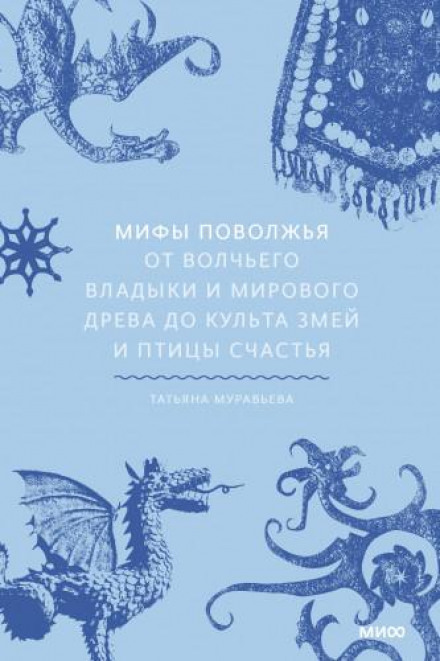
Myths of the Volga Region. From the Wolf Lord and the World Tree to the Cult of Snakes and the Bird of Happiness
10 hrs. 40 min.
Language
Russian
Author
Tatyana Muravyova
Author
Tatyana Muravyova
Narrator
Darya Berezovskaya
Narrator
Darya Berezovskaya
Description
Why did the great god Kugu Yumo lift the sky high above the earth? Who appears to people in the form of a destructive whirlwind? Which bird symbolizes the feminine principle? And what should you do when foul power is running wild?
The myths of the peoples of the Volga region became the subject of research in the 19th century. At that time, the mythological beliefs of the Mari, Udmurts, Chuvash, Mordvins, Tatars, Bashkirs, and Kalmyks seemed to have scattered into fairy tales and folk tales, sacred rituals, and beliefs. “Myths of the Volga Region” offers to piece together a beautiful, poetic picture composed of gods and heroes, bogatyrs and sorcerers; sacred animals, spirit-owners, household spirits, and giants.
From the author
The book “Myths of the Volga Region” is not a scholarly research work and does not claim to provide complete coverage of the subject. The reader will undoubtedly notice that the main focus here is not on theoretical discussion, but on retelling mythological plots. This is because the author set out to show myths first and foremost as a part of folk culture—works of folk creativity that reflected ideas about a well-thought-out arrangement of the world, and the beauty and harmony of the universe. Not by chance the famous folklorist, one of the largest representatives of the Russian mythological school, A. N. Afanasyev, called his fundamental study of Slavic mythology “Poetic Views of the Slavs on Nature.” This definition can apply to mythological beliefs of the most diverse peoples, because myths, besides other meanings they contain, inevitably carry an aesthetic element and reflect the poetic way of seeing the world that humanity has had since time immemorial. The author hopes that, having read this book, the reader will feel the beauty, imagery, and poetry of the myths of the Volga region.
Who this book is for
For lovers of history and mythology.
For those who are interested in Russian culture and the rites of the peoples of Russia.
For those who want to plunge into the past and find parallels with the present.
The myths of the peoples of the Volga region became the subject of research in the 19th century. At that time, the mythological beliefs of the Mari, Udmurts, Chuvash, Mordvins, Tatars, Bashkirs, and Kalmyks seemed to have scattered into fairy tales and folk tales, sacred rituals, and beliefs. “Myths of the Volga Region” offers to piece together a beautiful, poetic picture composed of gods and heroes, bogatyrs and sorcerers; sacred animals, spirit-owners, household spirits, and giants.
From the author
The book “Myths of the Volga Region” is not a scholarly research work and does not claim to provide complete coverage of the subject. The reader will undoubtedly notice that the main focus here is not on theoretical discussion, but on retelling mythological plots. This is because the author set out to show myths first and foremost as a part of folk culture—works of folk creativity that reflected ideas about a well-thought-out arrangement of the world, and the beauty and harmony of the universe. Not by chance the famous folklorist, one of the largest representatives of the Russian mythological school, A. N. Afanasyev, called his fundamental study of Slavic mythology “Poetic Views of the Slavs on Nature.” This definition can apply to mythological beliefs of the most diverse peoples, because myths, besides other meanings they contain, inevitably carry an aesthetic element and reflect the poetic way of seeing the world that humanity has had since time immemorial. The author hopes that, having read this book, the reader will feel the beauty, imagery, and poetry of the myths of the Volga region.
Who this book is for
For lovers of history and mythology.
For those who are interested in Russian culture and the rites of the peoples of Russia.
For those who want to plunge into the past and find parallels with the present.
