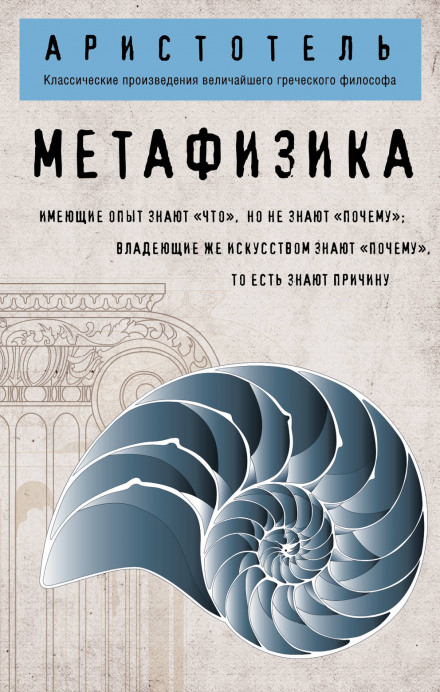
Metaphysics
12 hrs. 35 min.
Description
“Metaphysics” (from Ancient Greek τὰ μετὰ τὰ φυσικά — what comes after physics; abbreviation Aristot. Met.) is Aristotle’s most famous collection of works and the first foundational work of the eponymous branch of philosophy. It consists of 14 books compiled from various works by Andronicus of Rhodes, in which the teaching about first principles—the things that constitute the subject of wisdom—is described. These 14 books are commonly labeled with capital letters of the Greek alphabet. The exception is book 2, which is designated with a lowercase alpha[1]. Aristotle counts four first principles, or the highest causes of being: form (essence, the point of being) (“What is it?”), matter (“Out of what?”), purpose (“For what purpose?”), and the unmoved mover (“From where does motion begin?”). He also distinguishes between possibility and actuality. The last books of the Metaphysics are devoted to the critique of eidos as entities existing separately from things.
