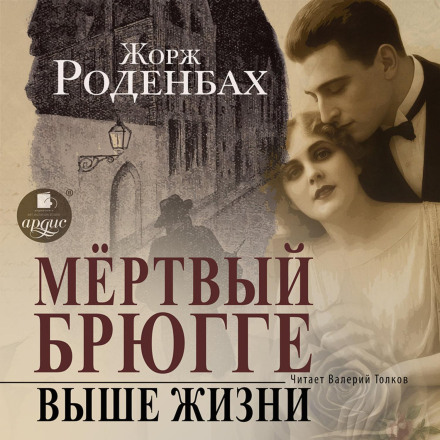
Bruges-la-Morte. The Mirage of Life
12 hrs. 15 min.
Language
Russian
Author
Georges Rodenbach
Author
Georges Rodenbach
Narrator
Valery Tolkov
Narrator
Valery Tolkov
Description
Annotation
Belgian poet and writer Georges Rodenbach (1855–1898) occupies a prominent place in the history of international symbolism through his poetry collections, as well as the novel “Dead Bruges,” which is considered a masterpiece of symbolism. The novel was printed in February 1892 in the newspaper “Figaro,” and by May it was published as a book. Rodenbach preceded the book with a warning: “In this fascinating study, we also— and first of all— wanted to address the city, the city as an important figure connected with the state of the soul, which advises, discourages, and prompts action. Thus, in fact, this Bruges that we chose with pleasure seems almost like a person… With its help, dominion is established over those who live there. It forms them in accordance with its sights and its bells. This is what we wanted to offer: a city guiding action; its cityscapes are no longer just a backdrop, as a few arbitrarily chosen descriptive themes, but are linked to the very event of the book.” The second novel included in the audiobook is also devoted to this city, and in the English translation it is titled “The Bells of Bruges.”
Belgian poet and writer Georges Rodenbach (1855–1898) occupies a prominent place in the history of international symbolism through his poetry collections, as well as the novel “Dead Bruges,” which is considered a masterpiece of symbolism. The novel was printed in February 1892 in the newspaper “Figaro,” and by May it was published as a book. Rodenbach preceded the book with a warning: “In this fascinating study, we also— and first of all— wanted to address the city, the city as an important figure connected with the state of the soul, which advises, discourages, and prompts action. Thus, in fact, this Bruges that we chose with pleasure seems almost like a person… With its help, dominion is established over those who live there. It forms them in accordance with its sights and its bells. This is what we wanted to offer: a city guiding action; its cityscapes are no longer just a backdrop, as a few arbitrarily chosen descriptive themes, but are linked to the very event of the book.” The second novel included in the audiobook is also devoted to this city, and in the English translation it is titled “The Bells of Bruges.”
