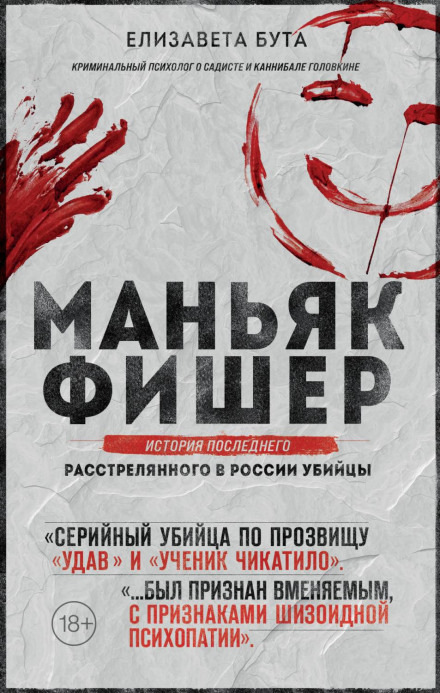
Maniac Fisher. The Story of the Last Executed Killer in Russia
8 hrs. 25 min.
Language
Russian
Author
Elizaveta Buta
Author
Elizaveta Buta
Narrator
Yury Katarmanov
Narrator
Yury Katarmanov
Description
In 1996, the last execution was carried out in Russia. In Moscow, an assassin of 11 children was shot.
…For a long time, no one could identify or establish who those human remains found near the Zvenigorod forest area belonged to. The bodies were so mutilated that only forensic experts could help—yet they still couldn’t write a conclusion. Everything suggested that the victims’ bodies belonged to boys around thirteen years old, but… aged too early. They say that when Andrey Chikatilo was shown photographs of the mutilated corpses, he recoiled in horror and disgust and said, “Even I can’t do something like that.”
Sergey Golovkin, a modest employee of a Moscow horse stud and one of Russia’s most dangerous serial killers, became a legend within just a few years of his “career.” His name was used to scare teenagers; people talked about him in evenings at pioneer camps. Only no one knew it was Golovkin. He was called “Fisher,” and he seemed more than human…
• Who was the real “monster” who actually set up a branch of the torture-hell in his own garage?
• How did “Uncle Seryozha,” respected by his colleagues and adored by students from a vocational training group, turn into a sadist and a murderer?
• Why was Fisher’s sentence carried out only after a moratorium on the death penalty had come into effect?
• How was Fisher able to remain unpunished for so many years?
This is told by a well-known criminal psychologist in a documentary thriller based on materials from interrogations and interviews with the killer.
…For a long time, no one could identify or establish who those human remains found near the Zvenigorod forest area belonged to. The bodies were so mutilated that only forensic experts could help—yet they still couldn’t write a conclusion. Everything suggested that the victims’ bodies belonged to boys around thirteen years old, but… aged too early. They say that when Andrey Chikatilo was shown photographs of the mutilated corpses, he recoiled in horror and disgust and said, “Even I can’t do something like that.”
Sergey Golovkin, a modest employee of a Moscow horse stud and one of Russia’s most dangerous serial killers, became a legend within just a few years of his “career.” His name was used to scare teenagers; people talked about him in evenings at pioneer camps. Only no one knew it was Golovkin. He was called “Fisher,” and he seemed more than human…
• Who was the real “monster” who actually set up a branch of the torture-hell in his own garage?
• How did “Uncle Seryozha,” respected by his colleagues and adored by students from a vocational training group, turn into a sadist and a murderer?
• Why was Fisher’s sentence carried out only after a moratorium on the death penalty had come into effect?
• How was Fisher able to remain unpunished for so many years?
This is told by a well-known criminal psychologist in a documentary thriller based on materials from interrogations and interviews with the killer.
100%
8:25:50
1
