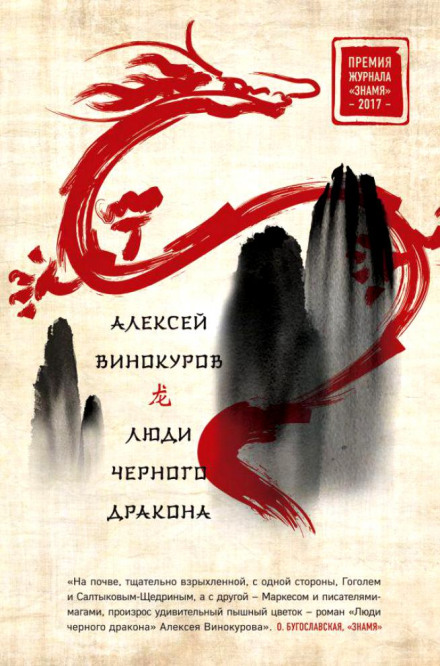
People of the Black Dragon
9 hrs. 33 min.
Language
Russian
Author
Alexey Vinokurov
Author
Alexey Vinokurov
Narrator
Vsevolod Kuznetsov
Narrator
Vsevolod Kuznetsov
Description
On the banks of the Amur River, which the Chinese call the River of the Black Dragon, representatives of three peoples live side by side in the village of Byvalom: Russians, Jews, and Chinese. This unusual neighborhood leads to a whole chain of ridiculous, mysterious, and sometimes simply hilarious events. “...A novel about peoples stretched out across time and space,”—that’s how I defined it. “I think the global problem is the coexistence of generations, of separate people, peoples—in this case Russians, Jews, and Chinese. Right now, as I feel it, the world stands on a very fragile foundation. And the writer, as it were, looks toward the approaching catastrophe, brings out a magnifying glass—and gives a chance for others too to see something vitally important. Why is Baikal so clean? Because in it there are tiny crustaceans that purify the water. It seems to me that writers, by their nature, are close to those crustaceans: what they do serves as a kind of antidote to the amount of darkness, evil, chaos, and entropy that spills into the world. A writer doesn’t necessarily offer a solution. But he sharpens the focus, shows the problem—and when a certain number of people look at it, the problem can be resolved…” — Alexey Vinokurov
