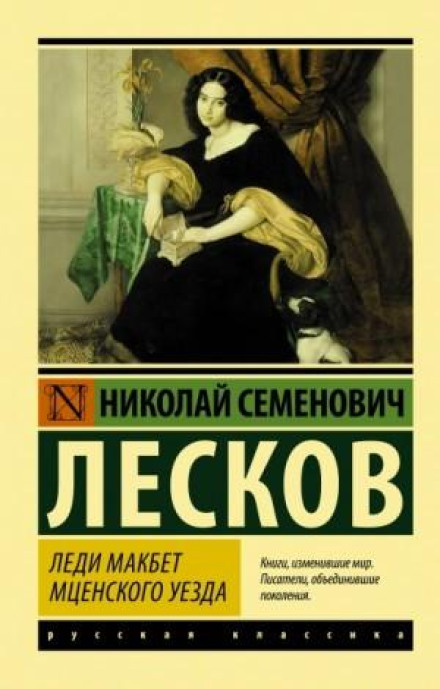
Lady Macbeth of the Mtsensk District. The Amazon. The Life of a Peasant Woman
2 hrs. 55 min.
Language
Russian
Author
Nikolai Leskov
Author
Nikolai Leskov
Narrator
Georgy Arsenyev
Narrator
Georgy Arsenyev
Description
A collection of portraits of Russian women, delivered in the unique manner of “Leskov’s storytelling.”
A tale about extraordinary Russian character and the deadly consequences of unrestrained passion—this is the first story of a woman, a serial killer in Russian literature.
The bored young merchant’s wife Katerina Izmailova, whose wild nature has nowhere to go in quiet empty rooms of a merchant’s house, begins an affair with a pretty-boy clerk, Sergey—and for the sake of this love, with astonishing cold-bloodedness, commits terrible crimes. By sketching her as “Lady Macbeth…” Leskov seems to give up invention in favor of the truth of life, creating the illusion of documentary style. In fact, “Lady Macbeth of Mtsensk County” is more than a life sketch: it’s a plot-driven novella, a tragedy, an anthropological study, and a domestic tale steeped in comedy.
Throughout his career, Leskov describes remarkable Russian fates: it’s not really about great or famous people, yet Leskov always manages to see something national in his heroes—and at the same time not stereotypical. The essay “The Warrior Woman” is devoted to the lace-maker Domna Platonovna—a woman with a complex character, knowing the whole world, confident in her own simplicity and gentleness, and yet—betrayer. The description of her various adventures looks like a tryout, a prelude to “The Enchanted Wanderer,” but the heroine’s language (“Wow, this just blew me up! I thought I’d throw it down, but I held back”) is completely self-sufficient—before us is one of the best examples of Russian storytelling, in which no one has surpassed Leskov.
In “The Life of a Woman,” Leskov gives the theme of serfdom and the reforms of Russia in the late 19th century a remarkably sharp and incisive treatment. The absence of a personal name in the title shifts the focus to the social aspect: one woman’s life becomes a generalization of the fate of all women of serfdom Russia.
Scholars classify the story “The Life of a Woman” as one of the “most sad tales about a Russian peasant woman.”
A tale about extraordinary Russian character and the deadly consequences of unrestrained passion—this is the first story of a woman, a serial killer in Russian literature.
The bored young merchant’s wife Katerina Izmailova, whose wild nature has nowhere to go in quiet empty rooms of a merchant’s house, begins an affair with a pretty-boy clerk, Sergey—and for the sake of this love, with astonishing cold-bloodedness, commits terrible crimes. By sketching her as “Lady Macbeth…” Leskov seems to give up invention in favor of the truth of life, creating the illusion of documentary style. In fact, “Lady Macbeth of Mtsensk County” is more than a life sketch: it’s a plot-driven novella, a tragedy, an anthropological study, and a domestic tale steeped in comedy.
Throughout his career, Leskov describes remarkable Russian fates: it’s not really about great or famous people, yet Leskov always manages to see something national in his heroes—and at the same time not stereotypical. The essay “The Warrior Woman” is devoted to the lace-maker Domna Platonovna—a woman with a complex character, knowing the whole world, confident in her own simplicity and gentleness, and yet—betrayer. The description of her various adventures looks like a tryout, a prelude to “The Enchanted Wanderer,” but the heroine’s language (“Wow, this just blew me up! I thought I’d throw it down, but I held back”) is completely self-sufficient—before us is one of the best examples of Russian storytelling, in which no one has surpassed Leskov.
In “The Life of a Woman,” Leskov gives the theme of serfdom and the reforms of Russia in the late 19th century a remarkably sharp and incisive treatment. The absence of a personal name in the title shifts the focus to the social aspect: one woman’s life becomes a generalization of the fate of all women of serfdom Russia.
Scholars classify the story “The Life of a Woman” as one of the “most sad tales about a Russian peasant woman.”
100%
05:55
1
06:51
2
06:00
3
04:07
4
02:28
5
17:11
6
13:10
7
06:23
8
05:32
9
06:42
10
05:24
11
06:44
12
05:38
13
09:07
14
12:07
15
19:25
16
17:01
17
25:54
18
