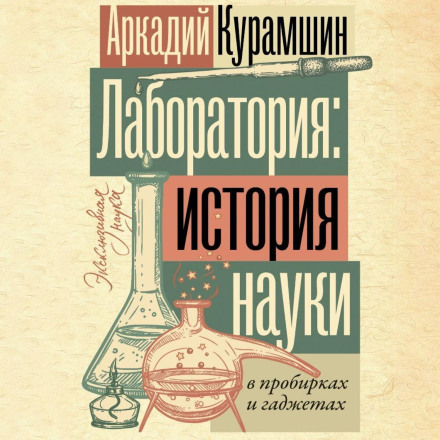
The Laboratory: A History of Science in Test Tubes and Gadgets
10 hrs. 15 min.
Language
Russian
Author
Arkady Kuramshin
Author
Arkady Kuramshin
Narrator
Vladimir Lesnykh
Narrator
Vladimir Lesnykh
Description
How can a chemist become famous? One way is to name after them a reaction they discovered, a new substance, or a reagent. If that’s not enough, a scientist can leave a mark in science by developing equipment or an instrument that will carry their name. Over time, these names may shrink down to a single surname, and in labs people often use them in everyday speech. For example, instead of “Liebig’s refrigerator,” people simply say “Liebig,” and a Wurtz attachment is called “Wurtz.”
This book presents devices created by scientists for their research. Do many people know who Petrie is—the one whose dish is used by chemists and microbiologists—or who invented the pipette that we use, for example, to instill drops into the eyes?
The author, an associate professor in the Department of High-Molecular and Element-Organic Compounds at the Chemical Institute of A. M. Butlerov, received the “Merit in Education” award in 2019. He is also a well-known popularizer of science and one of the leading science journalists writing about chemistry.
This book presents devices created by scientists for their research. Do many people know who Petrie is—the one whose dish is used by chemists and microbiologists—or who invented the pipette that we use, for example, to instill drops into the eyes?
The author, an associate professor in the Department of High-Molecular and Element-Organic Compounds at the Chemical Institute of A. M. Butlerov, received the “Merit in Education” award in 2019. He is also a well-known popularizer of science and one of the leading science journalists writing about chemistry.
