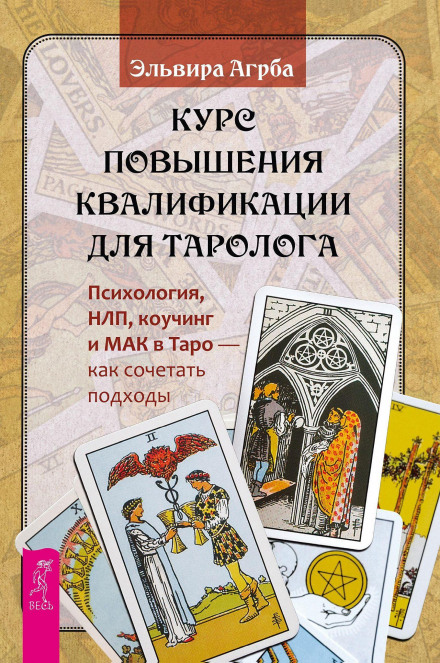
Advanced Training Course for Tarot Readers: Psychology, NLP, Coaching and Projective Cards in Tarot – How to Combine Approaches
4 hrs. 32 min.
Language
Russian
Author
Elvira Agrba
Author
Elvira Agrba
Narrator
Maria Kulikova
Narrator
Maria Kulikova
Description
Most often, a beginner tarot reader relies on intuition, but they don’t always know how to explain clearly to the client the process of reading the cards. They may get tangled in their own emotions, or become too deeply involved in someone else’s story. This book answers common questions that arise in practice: how to maintain professional boundaries, how to clarify and rephrase a request correctly, and how a card spread can support a person through real, meaningful changes. You’ll learn practical techniques from related fields so your consultations become gentler, more structured, and more effective.
You’ll learn to distinguish personal projections from the information provided by a tarot spread, build a safe session, and notice signs of fatigue and burnout in time. Instead of endlessly searching the internet for someone else’s patterns, you’ll start constructing your own spreads—tailored to a specific client and their particular task.
The book helps you avoid common mistakes that appear even among experienced practitioners. It provides support, reduces the anxiety of “what if I’m wrong,” and helps you develop a recognizable style without dependence on other people’s authority.
About the book
This book is about the tarot reader’s growth as a consultant and communicator. The author shows how to combine different approaches into a single system of working with clients: from understanding the request to leading the dialogue and closing the session.
The first chapter provides psychological foundations: ethics, development of emotional intelligence, the mechanisms of projection, the logic and stages of a consultation. Professional burnout and ways to prevent it and recover are covered separately.
The second chapter focuses on NLP tools (neuro-linguistic programming). You’ll work through key concepts and principles (presuppositions, rapport, the metamodel, the Milton model, reframing) and see how they help you hear the client more precisely and build communication more clearly.
The third chapter reveals a coaching approach: models for conducting sessions and a sequence of moving from a goal to results. You’ll learn how to lead a conversation so that the person finds solutions themselves and strengthens their inner support.
The fourth chapter introduces metaphorical associative cards—from basic principles of working with them to the idea of creating your own deck.
The fifth chapter brings the focus back to Tarot and shows how to combine all the tools you’ve learned into practice: keeping a journal, collecting observations, and developing original spreads. The book concludes with the sixth chapter, which offers ready-made spreads for different life situations.
Why you should read this book
You know the arcanas and their meanings, and you feel the depth of the symbols, but from time to time you get the sense that consultations lack precision and volume? You want to understand people more deeply, formulate answers more confidently, and turn a “vague request” into clear, workable guidance. This book will help you move from intuitive card reading to professional consulting.
The author brings together tarot reading with psychology, NLP, coaching, and MAC. As a result, you’ll begin to see the real internal processes behind the cards: you’ll be able to create a trusting space, protect yourself from burnout, and translate even complex stories into clear steps and decisions.
The material is organized progressively by increasing complexity: you’ll gradually strengthen key skills and build your own working system. Exercises and a separate chapter with spreads will help you transfer knowledge into practice quickly and apply it during consultations.
Who this book is for
• for tarot readers who have already mastered the basics and want to go further;
• for everyone who works with people and wants to understand their requests more deeply;
• for helping professionals—psychologists, coaches, and MAC consultants—who are looking for new ways to use Tarot in their work;
• for those who are on a path of self-discovery and want to use cards as a tool for personal growth;
• for those who want to reduce the risk of emotional burnout and learn how to set boundaries when working with people.
Why it was decided to publish this book
The book addresses two significant time-driven needs.
First, interest in “ecological” esotericism that is grounded in psychological literacy is growing: clients care not only about predictions, but also about a careful, respectful discussion of their situation in the format of a partner dialogue—where they are heard and respected.
Second, tarot readers themselves often become overwhelmed, lose confidence, and end up alone with someone else’s pain.
The author offers practical recommendations: how to remain empathetic without dissolving into the client’s problems; how to involve the person in discussion so they understand the logic behind the interpretation and the meaning of the recommendations they receive. This supports the specialist, helps preserve resources, and maintains interest in the work.
In the end, the book solves two tasks at once: it makes Tarot practice safer for the client and more sustainable and inspiring for the tarot reader.
About the author
Elvira Agrba is a writer, tarot reader, psychologist, NLP trainer, coach, entrepreneur, and teacher. Her academic interest in how the mind works is combined with a love for literature and art. In the past, she worked professionally in photography and owned a specialized store. She became interested in divinatory practices in early childhood. Part of her childhood was spent in the mountains of the Caucasus, preserving a sense of connection with nature and the culture of her ancestors.
She lives in Moscow, prefers a secluded lifestyle, explores altered states of consciousness, and combines esoteric approaches with classical psychology to make consultations deeper and more practical.
Key concepts
Tarot, psychology, NLP, coaching, consulting, client work, practical esotericism, self-discovery, metaphorical associative cards, MAC, professional burnout, ethics of a tarot reader, original spreads, working with a client
You’ll learn to distinguish personal projections from the information provided by a tarot spread, build a safe session, and notice signs of fatigue and burnout in time. Instead of endlessly searching the internet for someone else’s patterns, you’ll start constructing your own spreads—tailored to a specific client and their particular task.
The book helps you avoid common mistakes that appear even among experienced practitioners. It provides support, reduces the anxiety of “what if I’m wrong,” and helps you develop a recognizable style without dependence on other people’s authority.
About the book
This book is about the tarot reader’s growth as a consultant and communicator. The author shows how to combine different approaches into a single system of working with clients: from understanding the request to leading the dialogue and closing the session.
The first chapter provides psychological foundations: ethics, development of emotional intelligence, the mechanisms of projection, the logic and stages of a consultation. Professional burnout and ways to prevent it and recover are covered separately.
The second chapter focuses on NLP tools (neuro-linguistic programming). You’ll work through key concepts and principles (presuppositions, rapport, the metamodel, the Milton model, reframing) and see how they help you hear the client more precisely and build communication more clearly.
The third chapter reveals a coaching approach: models for conducting sessions and a sequence of moving from a goal to results. You’ll learn how to lead a conversation so that the person finds solutions themselves and strengthens their inner support.
The fourth chapter introduces metaphorical associative cards—from basic principles of working with them to the idea of creating your own deck.
The fifth chapter brings the focus back to Tarot and shows how to combine all the tools you’ve learned into practice: keeping a journal, collecting observations, and developing original spreads. The book concludes with the sixth chapter, which offers ready-made spreads for different life situations.
Why you should read this book
You know the arcanas and their meanings, and you feel the depth of the symbols, but from time to time you get the sense that consultations lack precision and volume? You want to understand people more deeply, formulate answers more confidently, and turn a “vague request” into clear, workable guidance. This book will help you move from intuitive card reading to professional consulting.
The author brings together tarot reading with psychology, NLP, coaching, and MAC. As a result, you’ll begin to see the real internal processes behind the cards: you’ll be able to create a trusting space, protect yourself from burnout, and translate even complex stories into clear steps and decisions.
The material is organized progressively by increasing complexity: you’ll gradually strengthen key skills and build your own working system. Exercises and a separate chapter with spreads will help you transfer knowledge into practice quickly and apply it during consultations.
Who this book is for
• for tarot readers who have already mastered the basics and want to go further;
• for everyone who works with people and wants to understand their requests more deeply;
• for helping professionals—psychologists, coaches, and MAC consultants—who are looking for new ways to use Tarot in their work;
• for those who are on a path of self-discovery and want to use cards as a tool for personal growth;
• for those who want to reduce the risk of emotional burnout and learn how to set boundaries when working with people.
Why it was decided to publish this book
The book addresses two significant time-driven needs.
First, interest in “ecological” esotericism that is grounded in psychological literacy is growing: clients care not only about predictions, but also about a careful, respectful discussion of their situation in the format of a partner dialogue—where they are heard and respected.
Second, tarot readers themselves often become overwhelmed, lose confidence, and end up alone with someone else’s pain.
The author offers practical recommendations: how to remain empathetic without dissolving into the client’s problems; how to involve the person in discussion so they understand the logic behind the interpretation and the meaning of the recommendations they receive. This supports the specialist, helps preserve resources, and maintains interest in the work.
In the end, the book solves two tasks at once: it makes Tarot practice safer for the client and more sustainable and inspiring for the tarot reader.
About the author
Elvira Agrba is a writer, tarot reader, psychologist, NLP trainer, coach, entrepreneur, and teacher. Her academic interest in how the mind works is combined with a love for literature and art. In the past, she worked professionally in photography and owned a specialized store. She became interested in divinatory practices in early childhood. Part of her childhood was spent in the mountains of the Caucasus, preserving a sense of connection with nature and the culture of her ancestors.
She lives in Moscow, prefers a secluded lifestyle, explores altered states of consciousness, and combines esoteric approaches with classical psychology to make consultations deeper and more practical.
Key concepts
Tarot, psychology, NLP, coaching, consulting, client work, practical esotericism, self-discovery, metaphorical associative cards, MAC, professional burnout, ethics of a tarot reader, original spreads, working with a client
100%
1:01:57
Курс повышения квалификации для таролога. Психология, НЛП, коучинг и МАК в Таро – как сочетать подходы 01
43:46
Курс повышения квалификации для таролога. Психология, НЛП, коучинг и МАК в Таро – как сочетать подходы 02
1:03:32
Курс повышения квалификации для таролога. Психология, НЛП, коучинг и МАК в Таро – как сочетать подходы 03
52:42
Курс повышения квалификации для таролога. Психология, НЛП, коучинг и МАК в Таро – как сочетать подходы 04
50:52
Курс повышения квалификации для таролога. Психология, НЛП, коучинг и МАК в Таро – как сочетать подходы 05
