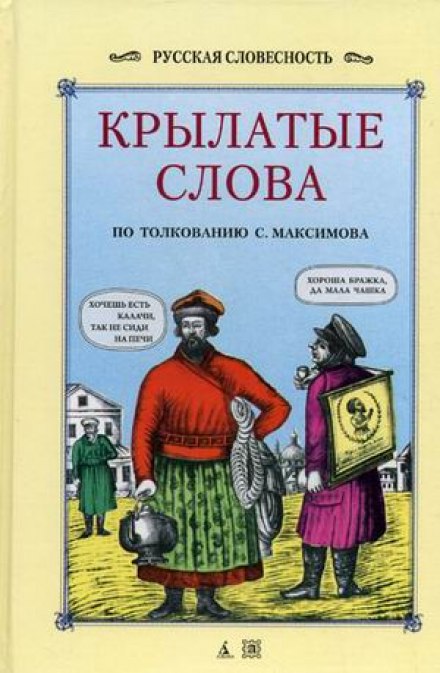
Winged Words and Expressions, Parables, Tales and Beliefs of the Russian People
4 hrs. 58 min.
Language
Russian
Author
Sergey Maksimov
Author
Sergey Maksimov
Narrator
Stanislav Fedosov
Narrator
Stanislav Fedosov
Description
Where is it—at the devil’s farthest? How can porridge praise itself: Why does the thief’s hat burn? What does a long box look like? Who are the Kazan orphans? Whom can you shut up under the belt? What are these little mockers, where you beat on a soporific (?), a slip you can get into, and the fuss you drag?
These and other common figurative expressions from the Russian language are described in vivid essays by the well-known ethnographer, connoisseur of folklore, historian, and writer Sergey Vasilyevich Maksimov.
Maksimov weaves into his narrative folk parables, beliefs, fairy tales, tales, and nonsense he collected during ethnographic journeys across different corners of Russia.
The audiobook will be interesting to the widest range of listeners—everyone interested in the Russian language and history.
These and other common figurative expressions from the Russian language are described in vivid essays by the well-known ethnographer, connoisseur of folklore, historian, and writer Sergey Vasilyevich Maksimov.
Maksimov weaves into his narrative folk parables, beliefs, fairy tales, tales, and nonsense he collected during ethnographic journeys across different corners of Russia.
The audiobook will be interesting to the widest range of listeners—everyone interested in the Russian language and history.
Contents:
- To get into a bind
- Batched wooden slats are beaten
- Lysa trees are sharpened (talk)
- Bast shoes are woven
- Bend into an arc
- The thief’s hat burns
- At the devil’s farthest
- Seven Fridays
- As far as a verst of Kolomna
- For the chickens’ laughter
- Kazan orphans
- Free will
- The long box
- Truth is in the legs
- As long as
- Sin in half
- A stone in one’s bosom
- To bow and be answered
- Where do crayfish spend the winter?
- Lean as a falcon
- Ovens and benches
- Smoke billows like a cornfield
- Brothers in arms
- Porridge praises itself
- Inside out
- Too much
- Devil take it
- On the eve
- As long as
- Except
- No homestead—no yard
- A pig in oranges
- To slip up
- Scraped as clean as a linden twig
- Turn one’s eyes away
- Someone else’s loaf
- Little scam
- Old sparrow
- Dragging out the fuss
- After the rain on Thursday
- Shut up with the belt
- No bottom, no cover
- No clue
- Let the red rooster out
- Like a stone thrown into water
- Galimatias (nonsense)
- Break yourself
- A true kerfuffle
- From the word go
- Emelya week
- Batched wooden slats are beaten
- Lysa trees are sharpened (talk)
- Bast shoes are woven
- Bend into an arc
- The thief’s hat burns
- At the devil’s farthest
- Seven Fridays
- As far as a verst of Kolomna
- For the chickens’ laughter
- Kazan orphans
- Free will
- The long box
- Truth is in the legs
- As long as
- Sin in half
- A stone in one’s bosom
- To bow and be answered
- Where do crayfish spend the winter?
- Lean as a falcon
- Ovens and benches
- Smoke billows like a cornfield
- Brothers in arms
- Porridge praises itself
- Inside out
- Too much
- Devil take it
- On the eve
- As long as
- Except
- No homestead—no yard
- A pig in oranges
- To slip up
- Scraped as clean as a linden twig
- Turn one’s eyes away
- Someone else’s loaf
- Little scam
- Old sparrow
- Dragging out the fuss
- After the rain on Thursday
- Shut up with the belt
- No bottom, no cover
- No clue
- Let the red rooster out
- Like a stone thrown into water
- Galimatias (nonsense)
- Break yourself
- A true kerfuffle
- From the word go
- Emelya week
