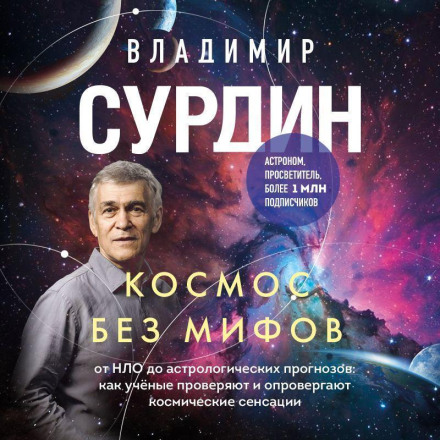
Space Without Myths. From UFOs to Astrological Forecasts: How Scientists Test and Disprove Cosmic Sensations
10 hrs. 11 min.
Language
Russian
Author
Vladimir Surdin
Author
Vladimir Surdin
Narrator
Vladimir Surdin
Narrator
Vladimir Surdin
Description
Have you heard that police chases involving “flying saucers” often end somewhere around Venus? And that astrological predictions tried to confirm themselves in thousands of marriages and careers—but statistics didn’t support them?
Vladimir Surdin, an astronomer at Moscow State University and one of the main popularizers of space science, gathered in his new book a dispassionate scientific investigation. Instead of legends, you get verification of facts: how the Petrozavodsk phenomenon can be explained, where the myths about “lunar bases” come from, and why the human brain mistakes Starlink satellite chains for UFOs. You’ll learn how the “giant ball” over Ivanovo turned out to be just the Moon near the horizon, and how the “unidentified objects” that cosmonauts see are often just particles and fragments of their own craft.
Here, you’re not asked to believe or not believe—you’re given tools. A step-by-step approach helps distinguish an Iridium satellite flare from a “spaceship,” estimate the angular size of the observed object, and understand why horoscopes are not science, but a form of social self-deception.
This book is for people who care more about evidence than magical thinking—and who want to understand phenomena so they can grasp what’s really going on.
Vladimir Surdin, an astronomer at Moscow State University and one of the main popularizers of space science, gathered in his new book a dispassionate scientific investigation. Instead of legends, you get verification of facts: how the Petrozavodsk phenomenon can be explained, where the myths about “lunar bases” come from, and why the human brain mistakes Starlink satellite chains for UFOs. You’ll learn how the “giant ball” over Ivanovo turned out to be just the Moon near the horizon, and how the “unidentified objects” that cosmonauts see are often just particles and fragments of their own craft.
Here, you’re not asked to believe or not believe—you’re given tools. A step-by-step approach helps distinguish an Iridium satellite flare from a “spaceship,” estimate the angular size of the observed object, and understand why horoscopes are not science, but a form of social self-deception.
This book is for people who care more about evidence than magical thinking—and who want to understand phenomena so they can grasp what’s really going on.
100%
1:44:45
Космос без мифов. От НЛО до астрологических прогнозов: как учёные проверяют и опровергают космические сенсации 01
44:59
Космос без мифов. От НЛО до астрологических прогнозов: как учёные проверяют и опровергают космические сенсации 02
1:53:04
Космос без мифов. От НЛО до астрологических прогнозов: как учёные проверяют и опровергают космические сенсации 03
45:53
Космос без мифов. От НЛО до астрологических прогнозов: как учёные проверяют и опровергают космические сенсации 04
58:31
Космос без мифов. От НЛО до астрологических прогнозов: как учёные проверяют и опровергают космические сенсации 05
1:47:37
Космос без мифов. От НЛО до астрологических прогнозов: как учёные проверяют и опровергают космические сенсации 06
59:20
Космос без мифов. От НЛО до астрологических прогнозов: как учёные проверяют и опровергают космические сенсации 07
1:17:37
Космос без мифов. От НЛО до астрологических прогнозов: как учёные проверяют и опровергают космические сенсации 08
