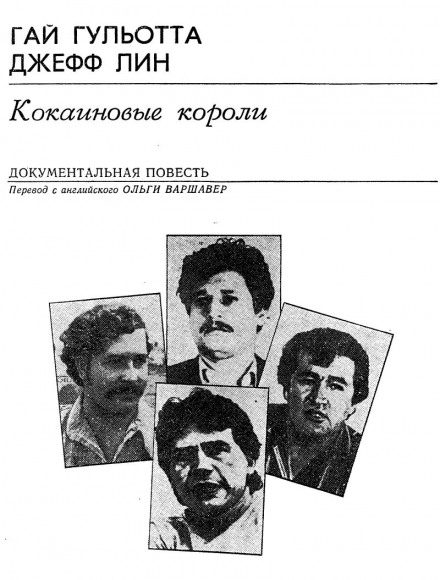
Kings of Cocaine
9 hrs. 13 min.
Language
Russian
Author
Guy Gugliotta
Author
Guy Gugliotta
Narrator
Viktor Tkachenko
Narrator
Viktor Tkachenko
Description
Among the three main drug markets (heroin, cocaine, and marijuana/hashish), the cocaine market is covered in scientific literature in the greatest detail. The reason is fairly simple. While other drugs of plant origin are produced mainly in backward countries (Myanmar, Afghanistan), which are inaccessible or even completely closed to modern researchers, the Latin American countries from which the “cocaine rivers” begin are, with all caveats, societies with a Europeanized culture. Since the cocaine drug business is the most “transparent” to researchers, there are credible estimates of its main macro-indicators.
The documentary novella by Guy Gulotta was published in the journal “Inostrannaya Literatura” (Foreign Literature) in 1991, no. 3, in the translation of Olga Aleksandrovna Varshaver.
Cocaine smuggling to the United States was first mastered in the early 1970s by the Cuban mafia that settled in Florida. In 1976–1979, the Colombians—who previously limited themselves to the role of intermediaries—ousted the Cubans and took control of the lion’s share (up to 80%) of the American cocaine market. The “Medellín drug cartel era” began, lasting for a little over a decade.
The Colombians’ expansion triggered a sharp reaction from U.S. law enforcement, which focused its efforts specifically on fighting the Medellín cartel. The “crusade” started in 1984 with the dismantling of several cocaine laboratories in the jungles of Colombia. The Medellín men picked up the gauntlet thrown at them, unleashing real terror against law-enforcement forces and political leaders. An additional factor intensifying Colombia’s “drug war” was the “cartel war” that began in 1988 between the “old-timers” from Medellín and the “newcomers” from Cali—who were hunted with less zeal, which allowed them to push aside competitors.
The documentary novella by Guy Gulotta was published in the journal “Inostrannaya Literatura” (Foreign Literature) in 1991, no. 3, in the translation of Olga Aleksandrovna Varshaver.
Cocaine smuggling to the United States was first mastered in the early 1970s by the Cuban mafia that settled in Florida. In 1976–1979, the Colombians—who previously limited themselves to the role of intermediaries—ousted the Cubans and took control of the lion’s share (up to 80%) of the American cocaine market. The “Medellín drug cartel era” began, lasting for a little over a decade.
The Colombians’ expansion triggered a sharp reaction from U.S. law enforcement, which focused its efforts specifically on fighting the Medellín cartel. The “crusade” started in 1984 with the dismantling of several cocaine laboratories in the jungles of Colombia. The Medellín men picked up the gauntlet thrown at them, unleashing real terror against law-enforcement forces and political leaders. An additional factor intensifying Colombia’s “drug war” was the “cartel war” that began in 1988 between the “old-timers” from Medellín and the “newcomers” from Cali—who were hunted with less zeal, which allowed them to push aside competitors.
100%
33:59
0001
28:24
0002
18:55
0003
25:33
0004
20:39
0005
19:36
0006
14:39
0007
16:17
0008
17:22
0009
25:22
0010
21:34
0011
21:59
0012
18:10
0013
10:48
0014
27:27
0015
27:02
0016
27:34
0017
17:54
0018
14:43
0019
20:44
0020
13:38
0021
15:38
0022
09:59
0023
23:04
0024
24:36
0025
13:11
0026
24:59
0027
