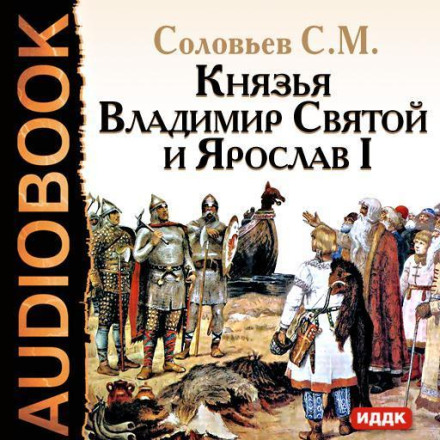
Princes Vladimir the Holy and Yaroslav I
2 hrs. 48 min.
Language
Russian
Author
Sergey Solovyov
Author
Sergey Solovyov
Narrator
Leontina Brotskaya
Narrator
Leontina Brotskaya
Description
The internecine wars of Yaryopolk, Oleg, and Vladimir—sons of Svyatoslav, who had already divided his lands among them during his lifetime—ended in the death of Yaryopolk and Oleg and the triumph of Vladimir (980–1015). Vladimir took from the Poles the “Red Rus’,” fought against the Bulgars and the Pechenegs, and spared no rich spoils for his retinue or for decorating the many idols he had. Greek preachers succeeded in persuading even the prince himself to accept Christianity. The baptism of Vladimir and his close circle, and then of all the people of Kyiv, took place in 988. The Greek emperors, Basil and Constantine, married their sister Anna to Vladimir. Christianity was actively spread by the princely retinue and priests throughout the lands of the principality. The people loved Vladimir for his gentle nature and his rare love of neighbors. Vladimir built cities and churches, and at the churches—schools for teaching literacy. It was also under him that monastic building began in Rus’. In folk songs and old epics (bylinas), the kind-hearted prince, Vladimir “the Red Sun,” is often mentioned; the Russian Church calls him the equal-to-the-Apostles prince.
After the expulsion of Svyatopolk and with the death of Mstislav of Tmutorakan, Prince Yaroslav (1019–1054) became the sole ruler of the Rus’ land. Endowed with great wisdom, he ruled skillfully: he took much care of the country’s needs, built cities (Yaroslav and Yuryev), erected churches (St. Sophia in Kyiv and Novgorod), established schools, and promoted literacy in Rus’. He also deserves credit for issuing the first compilation of legal customs, known as “Russkaya Pravda” (Russian Justice). To his sons—Iziaslav, Svyatoslav, Vsevolod, Igor, and Viacheslav—he gave portions of the Rus’ land and advised them to live peacefully, in unity, and in love among themselves. The people called Yaroslav “the Wise.”
After the expulsion of Svyatopolk and with the death of Mstislav of Tmutorakan, Prince Yaroslav (1019–1054) became the sole ruler of the Rus’ land. Endowed with great wisdom, he ruled skillfully: he took much care of the country’s needs, built cities (Yaroslav and Yuryev), erected churches (St. Sophia in Kyiv and Novgorod), established schools, and promoted literacy in Rus’. He also deserves credit for issuing the first compilation of legal customs, known as “Russkaya Pravda” (Russian Justice). To his sons—Iziaslav, Svyatoslav, Vsevolod, Igor, and Viacheslav—he gave portions of the Rus’ land and advised them to live peacefully, in unity, and in love among themselves. The people called Yaroslav “the Wise.”
100%
15:02
Князья Владимир Святой и Ярослав I 01
15:11
Князья Владимир Святой и Ярослав I 02
15:17
Князья Владимир Святой и Ярослав I 03
15:28
Князья Владимир Святой и Ярослав I 04
15:28
Князья Владимир Святой и Ярослав I 05
15:42
Князья Владимир Святой и Ярослав I 06
15:37
Князья Владимир Святой и Ярослав I 07
15:33
Князья Владимир Святой и Ярослав I 08
15:29
Князья Владимир Святой и Ярослав I 09
15:29
Князья Владимир Святой и Ярослав I 10
14:01
Князья Владимир Святой и Ярослав I 11
