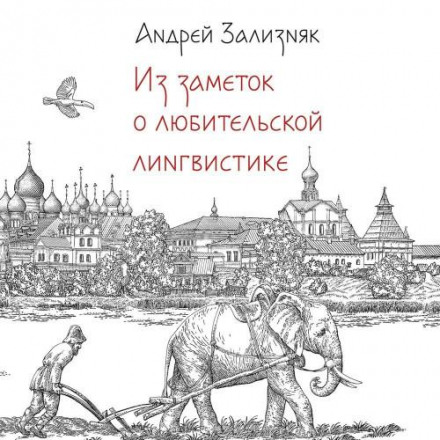
From Notes on Amateur Linguistics
7 hrs. 33 min.
Language
Russian
Author
Andrey Zaliznyak
Author
Andrey Zaliznyak
Narrator
Alexey Komissarov
Narrator
Alexey Komissarov
Description
In modern publications, amateur speculations about the origin of words have become widespread. These are not based on the scholarly study of the history of languages, but on a naive belief that such reasoning requires no special knowledge—just simple guesses. Moreover, based on amateur guesses about word origins, these works often draw completely fantastic conclusions about the history of entire peoples.
After all, this isn’t mathematics—none of the arguments are absolute. So if a researcher has a strong incentive to “pull” the evidence in a certain direction, the specifics of the matter, alas, make it all too easy to realize that pull: to find more and more arguments in favor of one’s side, without noticing it oneself—while quietly inflating the significance of one’s arguments and minimizing the significance of opposing ones.
In A. A. Zaliznyak’s work, it is shown how such reasoning differs from professional linguistics and why it has no chance of uncovering the true history of words. Special attention is given to the most striking example of using amateur linguistics to construct a fictitious history of many countries—the so-called “new chronology” of A. T. Fomenko.
The second edition also includes the article “On the ‘Veles Book.’”
I would like to defend two simplest ideas that were previously considered obvious—even banal—and now sound very unfashionable:
1) Truth exists, and the purpose of science is to find it.
2) In any issue under discussion, a professional (if they are truly a professional, not merely a bearer of official titles) is, in the normal case, more right than a dilettante.
For whom
For readers interested in philology and linguistics. Useful both for professional linguists and for people who are only just beginning to study linguistics. In this book, Zaliznyak discusses various linguistic phenomena and problems such as word origins, grammatical constructions, and idioms. Thus, the book may be of interest and benefit to everyone who wants to expand their knowledge in the field of linguistics and philology.
After all, this isn’t mathematics—none of the arguments are absolute. So if a researcher has a strong incentive to “pull” the evidence in a certain direction, the specifics of the matter, alas, make it all too easy to realize that pull: to find more and more arguments in favor of one’s side, without noticing it oneself—while quietly inflating the significance of one’s arguments and minimizing the significance of opposing ones.
In A. A. Zaliznyak’s work, it is shown how such reasoning differs from professional linguistics and why it has no chance of uncovering the true history of words. Special attention is given to the most striking example of using amateur linguistics to construct a fictitious history of many countries—the so-called “new chronology” of A. T. Fomenko.
The second edition also includes the article “On the ‘Veles Book.’”
I would like to defend two simplest ideas that were previously considered obvious—even banal—and now sound very unfashionable:
1) Truth exists, and the purpose of science is to find it.
2) In any issue under discussion, a professional (if they are truly a professional, not merely a bearer of official titles) is, in the normal case, more right than a dilettante.
For whom
For readers interested in philology and linguistics. Useful both for professional linguists and for people who are only just beginning to study linguistics. In this book, Zaliznyak discusses various linguistic phenomena and problems such as word origins, grammatical constructions, and idioms. Thus, the book may be of interest and benefit to everyone who wants to expand their knowledge in the field of linguistics and philology.
