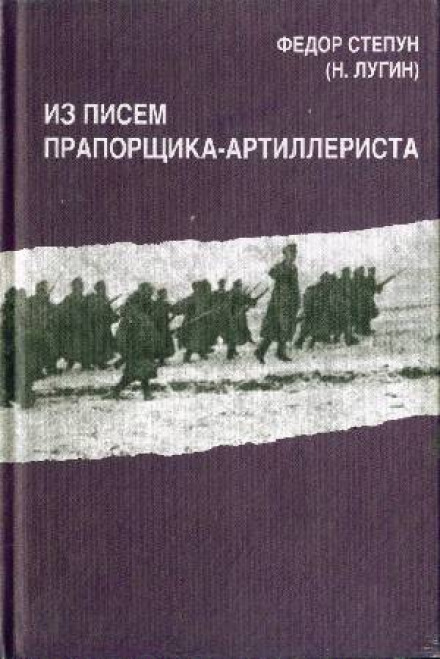
From the Letters of an Artillery Ensign
5 hrs. 55 min.
Language
Russian
Author
Fedor Stepun
Author
Fedor Stepun
Narrator
Alexander Krupinin
Narrator
Alexander Krupinin
Description
The Great War is contemplated by outstanding Russian philosopher Fyodor Avgustovich Stepun. Like Ernst Jünger’s memoirs “In Stahlgewittern” (“In Steel Storms”), it is a view of the war from the perspective of an eyewitness and participant.
Fyodor Avgustovich Stepun’s memoirs are similar to Jünger’s book in many ways: the author is likewise a well-known philosopher in the future, the text is likewise popular, and it was likewise published “hot on the heels of events.” There is also another similarity—Fyodor Avgustovich is also German. But a German who is Russian. His father came from East Prussia, and his mother from a Swedish-Finnish line. Yet here is the paradox: it is known that no one could express the peculiarity of Russianness better than people from other nations (let’s recall Vladimir Ivanovich Dahl’s “Explanatory Dictionary of the Living Great Russian Language,” the son of a Russified Danishman).
However, the memoirs—more precisely, the letters—of Fyodor Avgustovich Stepun sharply contrast with Ernst Jünger’s “vignettes from life” that do not notice certain circumstances of the war, and above all the attitude toward it and its perception. One might think that Germans are all belligerent, including the civilians, and Russians are all pacifists, not excluding professional soldiers. But that would be too superficial a judgment. Both authors are familiar with the glory of war, the nobility so sharply outlined in wartime, with the feat, bravery, and self-sacrifice.
Stepun offers us immersion into the soul of the warring Russian Imperial Army—into the souls of officers and soldiers, into the soul of events, the soul of everyday life and nature around them. Stepun’s texts are distinguished by their interpretation of the senselessness of war and, at the same time, the dishonor of not fighting or showing cowardice in war. His understanding is inspired by the characteristic Russian melancholy that combines lyricism against the backdrop of ominous events of the modern age, and by the sharpening—up to the limits of what is imaginable—of moral dilemmas.
Fyodor Avgustovich Stepun died in 1965 at the age of 81, having survived the expulsion into emigration in 1922 among prominent figures of the Russian intelligentsia. In 1947 he headed the Department of History of Russian Culture at the University of Munich. His memoirs-reflections “The Past and What Did Not Happen” are considered one of the deepest books that interprets Russia’s fate and the revolution of 1917.
Fyodor Avgustovich Stepun’s memoirs are similar to Jünger’s book in many ways: the author is likewise a well-known philosopher in the future, the text is likewise popular, and it was likewise published “hot on the heels of events.” There is also another similarity—Fyodor Avgustovich is also German. But a German who is Russian. His father came from East Prussia, and his mother from a Swedish-Finnish line. Yet here is the paradox: it is known that no one could express the peculiarity of Russianness better than people from other nations (let’s recall Vladimir Ivanovich Dahl’s “Explanatory Dictionary of the Living Great Russian Language,” the son of a Russified Danishman).
However, the memoirs—more precisely, the letters—of Fyodor Avgustovich Stepun sharply contrast with Ernst Jünger’s “vignettes from life” that do not notice certain circumstances of the war, and above all the attitude toward it and its perception. One might think that Germans are all belligerent, including the civilians, and Russians are all pacifists, not excluding professional soldiers. But that would be too superficial a judgment. Both authors are familiar with the glory of war, the nobility so sharply outlined in wartime, with the feat, bravery, and self-sacrifice.
Stepun offers us immersion into the soul of the warring Russian Imperial Army—into the souls of officers and soldiers, into the soul of events, the soul of everyday life and nature around them. Stepun’s texts are distinguished by their interpretation of the senselessness of war and, at the same time, the dishonor of not fighting or showing cowardice in war. His understanding is inspired by the characteristic Russian melancholy that combines lyricism against the backdrop of ominous events of the modern age, and by the sharpening—up to the limits of what is imaginable—of moral dilemmas.
Fyodor Avgustovich Stepun died in 1965 at the age of 81, having survived the expulsion into emigration in 1922 among prominent figures of the Russian intelligentsia. In 1947 he headed the Department of History of Russian Culture at the University of Munich. His memoirs-reflections “The Past and What Did Not Happen” are considered one of the deepest books that interprets Russia’s fate and the revolution of 1917.
100%
19:04
01-stepun
22:37
02-stepun
26:51
03-stepun
21:38
04-stepun
24:12
05-stepun
23:57
06-stepun
23:48
07-stepun
17:54
08-stepun
22:17
09-stepun
19:03
10-stepun
22:43
11-stepun
21:46
12-stepun
24:59
13-stepun
27:08
14-stepun
18:56
15-stepun
18:31
16-stepun
